Search 2.0

Wednesday, April 20, 2011

Remembering a gypsy songman

John Vandiver
I have only five framed photographs hanging on the wall in the office of my home, the place where I compose the entries for this journal. One is of a reflection pool in Seville, Spain, one of the few photographs I took of which I am incredibly proud. There are also photographs of my son Chance when he was 3, my marvelous granddaughter Grace, and my younger brother Jim who died almost 25 years ago and whom I still miss every single day. The other photograph is of John Vandiver taken during a performance at Rockefeller’s in Houston. John is at the center and he is flanked in the photograph by such other great musicians as Shake Russell, Michael Mashkes, Michael Mercoulier and Dana Cooper.

For the first 25 years of its existence I attended every single Kerrville Folk Festival. I especially remember the 1979 edition. Chance was less than a year old and this festival was his first experience outside the four walls of our Dallas home. I figured he would, at most, take three days and nights of tent living before insisting we had back north. To my wonderful surprise and amazement, the only time he threw a fit was when we folded the tent to leave after spending three weeks at Quiet Valley Ranch.

Anyway, John was on stage at one particular afternoon performance that year singing his incredible version of Cake Walk Into Town, when Chance got up from his seat next to me and began “cake walking” toward the stage. It marked his first steps on his own.

As the years and the festivals wore on, Chance and John developed their own special friendship. John would bring this old nag of a horse with him to the ranch and Chance fell in love with that animal. He would spend all day at the fence line reaching through the wire to pet and talk to the horse. As a result, John decided to call the horse “Chance.”

I remember once, a couple of weeks before John was murdered, taking Billy Gibbons of ZZ Top to a Houston club to see John perform. Billy could only stay through about a half-dozen numbers, but when we left he promised me he was going to get John into a recording studio and produce a album by him.

The weekend John was killed he called me and asked if Chance and I could come to Magnolia to spend that weekend at his ranch. As fate would have it, I already made other plans. I later came to learn I was down the list of people John called that day asking them to spend the weekend with him. He must have had a premonition.

I also remember very well being awakened at 3:20 a.m. that Saturday morning by a ringing telephone. At the other end of the line was Michael Mashkes telling me that John had been murdered.

All these thoughts came back to me this evening as I read singer/songwriter Robert Earl Keen’s fitting tribute to the Gypsy Songman. It is well worth the time it takes to read it.

Film to claim Onassis financed RFK assassination


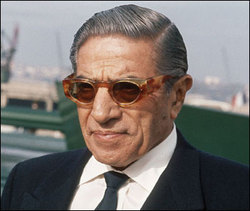
Aristotle Onassis

Fernando Meirelles, the director of The Constant Gardener among other works, is planning a film biography of Aristotle Onassis that will not concentrate on his relationship with Jackie Kennedy, the widow of President John K. Kennedy, but on the Greek shipping magnate’s contentious dealings with the President’s brother.

The film, titled simply Onassis, will be adapted from a book written by Peter Evans and, according to this story, “As attorney general, Bobby had investigated Onassis’s sketchy international business practices and banned him from trading with the U.S., and Evans wrote that their rivalry over control of and access to Jackie culminated in Onassis’s alleged financing of the assassination of the presidential hopeful.”

Is this the end of Batman?

I didn’t find the fact that Oscar winner Marion Cotillard and Joseph Gordon-Levett were reuniting with director Christopher Nolan for The Dark Knight Rises nearly as interesting as the fact the news release announcing the casting referred to the film as “the epic conclusion to the Dark Night legend.”

What’s with this “epic conclusion” business? Is Nolan, who is co-writing the screenplay from a story he co-authored, planning to bump off Batman? Is Nolan going to forever deprive Batman of a Robin? Everyone knows Nolan was not planning on directing another Batman film, but is he going to do his best to keep everyone else away as well?

I guess we’ll have to wait until July 2012, when the film is scheduled to open, to learn the answers.

Cuban getting out of the movie biz?

According to this report, Mark Cuban is putting the Landmark theaters and Magnolia Pictures on the auction block. That doesn’t mean he’s going to sell, but he’s trolling the financial waters to see if any big fish will bite. I gotta think Cube wouldn’t be going to all this trouble unless he planned to unload, but I guess we’ll just have to wait and see. I also wonder why no local media was on this story.

Rumblings from Roger

Film critic Roger Ebert recently posed an interesting rhetorical question. “Why is it you never see this headline: ‘Psychic wins lottery’?”

Tuesday, April 19, 2011

Available on DVD: “Four Lions”

Four Lions is a comedy about terrorism. No, not a thoughtful, intellectual take on the absurdities of suicide bombing. It’s slapstick. Actually, it’s the Three Stooges of Jihad. Or five, really: Five working-class young men from northern England meet in secret to plan suicide bombings but are so inept they cannot even agree on what to bomb.

“What we gonna blow up, Waj?”

“The Internet.”

“We should bomb the mosque,” says Barry. “It will radicalize the moderates.”

He then begins taping his video claiming credit for the planned attack.

That profound lack of connection between thought and action — how the video undermines the goal of the bombing — is a constant through the film. These are real idiots. In fact, they are clearly more in love with the idea of jihad than they are with any actual goals or strategies. In love with the trappings: the guns, the bombs, the videos, the buzzwords and, above all, the posturing. When one makes a threatening video, holding a toy gun, he is told the gun is too small to be believable. “No, my hands are too big,” he responds.

But that is already taking the film too seriously. Really, these guys are just knuckleheads. And the movie is full of outrageous laughs. One comforts another at the thought of dying: “Don’t worry, you’ll be in heaven before your head hits the ceiling.” Another films himself singing a rap song: “I’m the mujahideen and I’m making a scene/ Now you’s gonna feel what the boom-boom means.”

As a viewer, you’re stuck. The subject would not seem to be funny in any way. Terrorism is clearly a serious matter. Yet, funny is funny, and you laugh despite yourself. After all, with the Times Square car bomber, who locked his keys in the car, and after the underwear bomber, you begin to see that not everyone involved is a Ph.D.

And the absurdities of their beliefs keep piling up. When their car breaks down, one of them claims, “It’s the parts. They’re Jewish.”

What part of the car is Jewish?

“The spark plugs. Jews invented spark plugs to control global traffic.”

The film never makes fun of Islam itself. In fact, Islam hardly comes up at all, in any substantive way. No, this is about idiots and fundamentalism. About zealotry and violence. Our gang never discusses religion; rather, they discuss whether the battery is running low on their video camera.

I did have some major problems. The movie is set in Sheffield, England, and the working-class accents are sometimes impenetrable. The DVD should have included English subtitles (only Spanish ones are offered). But even then, the argot is so thick, even subtitles wouldn’t help: “You givin’ me batty chirps, bro? You calling me a whammer?”

Also, the film betrays its low-budget origins in cinematography, editing, acting and locations. Really, none of that finally matters. Mainly, you’ll laugh even through the credits which contain the notation: “One sheep was harmed in the making of this film.”

I now have something in common with Nicolas Cage

I, too, have been drunk in New Orleans. However, I never did any of that other stuff

Who is Ricardo Sanchez and why are all those Democrats talking about him?

Ricardo Sanchez
To answer the first question, Sanchez, a native of Rio Grande City, was once the Numero Uno military commander in Iraq. Unfortunately, for him, he was the Top Dog during that time when the Abu Ghraib prisoner abuse stuff broke. In a memo signed by General Sanchez and later acquired by the ACLU through a Freedom of Information Act request, techniques were authorized to interrogate prisoners, including “environmental manipulation” such as making a room hot or cold or using an “unpleasant smell,” isolating a prisoner, disrupting normal sleep patterns and “convincing the detainee that individuals from a country other than the United States are interrogating him.” In return, Sanchez said the ALCU was “a bunch of sensationalist liars, I mean lawyers, that will distort any and all information that they get to draw attention to their positions.” Although he was never formally charged with anything, the scandal effectively ended his military career and he retired in 2006 to write his memoirs and other things.

To answer the second question, Democrats are actively recruiting Sanchez to run for the U.S. Senate seat currently held by the retiring Kay Bailey Hutchison.

“I would describe myself as during my military career as supporting the president and the Constitution,” Sanchez said in a recent interview. “After the military, I decided that socially, I’m a progressive, a fiscal conservative and a strong supporter, obviously, of national defense.”

He also said his political views have been shaped by his Rio Grande Valley upbringing.

“It’s my views and my history, having grown up in south Texas, depending on social programs and assistance, that America has a responsibility to its people,” he said in the same interview.

I dunno. It seems to me the guy is carrying a lot of negative baggage to be seriously considered a viable candidate. But maybe these crazy Texans might think that the techniques employed at Abu Ghraib are just what we need to solve our immigrant problem and putting all those uppity gay marriage folks where they belong.

DART may tie rates to where riders live’

DART has a plan to get break even.

David Leininger, CFO of Dallas Area Rapid Transit, recently told a panel discussing the future of Dallas, that staff is talking to the DART board about instituting a higher rate for those residents living in cities that are not DART members. My question, obviously, is how are they going to know who is who. Anyway, here’s what the man had to say on the subject:

Our demand has grown beyond our boundaries. One of our biggest challenges is dealing with Frisco and McKinney and all of the areas north of our service area. Ten percent of all trips are generated at our end-of the-line stations; 55 percent of those end-of-line riders are “non-residents,” or people who live outside of DART, and that rate is growing. At the time that the plan was put together, 25 years ago, out-of-area ridership was probably 1 or 2 percent. We are spending, on light rail alone, in terms of subsidies to people who live outside our service area, roughly $20 million on the operating side. If you fold in the capital costs associated with it, it’s about $50 million a year in expense for riders who do not live in the service area and whose cities do not contribute to DART. That’s the big economic challenge that we’ve got to address. There is literally a discussion going on with our board now, to have non-resident and resident price differentiation. And it would be a big differentiation. It wouldn’t be 25 cents, I can tell you that.

Bachman: “God is homophobic”


Michelle Bachmann

Michelle Bachmann, that looney representative from Minnesota, claims God told her to propose amendments to the Minnesota state constitution outlawing gay marriage. This wacko, who is actually mounting a presidential campaign, was trying to drum up votes in the early caucus state of Iowa during the weekend and told a group of two or three supporters there that one day back in 2003 or so she was letting it all hang out listening to her favorite Christian radio station when she heard that the Massachusetts Supreme Court ruled gay marriages were constitutional.

“When that happened, I heard the news on my local Christian radio station in Minneapolis-St. Paul and I was devastated,” she said. “And I took a walk and I just went to prayer and I said, ‘Lord, what would you have me do in the Minnesota state Senate?’ And just through prayer I knew that I was to introduce the marriage amendment in Minnesota.”

Fortunately enough, while Bachmann was conferring with her homophobic God, the rest of the Minnesota state senators were channeling Rock Hudson and her attempt failed. But she tried again. Once more wiser heads prevailed and Bachman’s proposal was shot down.

Sunday, April 17, 2011

Memo to ESPN: Bring ‘em back alive!

Jon Miller and Joe Morgan

I was watching the Rangers-Yankees baseball game on ESPN tonight and even more painful than the Texas loss was listening to the broadcasters. ESPN needs to get Jon Miller and Joe Morgan back in the telecast booth as soon as possible. Only Vin Scully is a better play-by-play broadcaster than Miller, and Morgan has forgotten more baseball strategy than Bobby Valentine will ever admit to knowing. At the very least, the Miller-Morgan team know the head guy in the dugout is the “manager” and not the “head coach” as I heard last night. Ouch!

Available on DVD: “A Film Unfinished”


Even the most harrowing drama is still, at its core, a form of entertainment — a way to pass the time. But A Film Unfinished shows that the medium can be used for more nefarious purposes, as a tool of propaganda, even a weapon in war.

Yael Hersonski’s documentary is infuriating, heartbreaking, devastating — and scary. It depicts a lie upon a lie. The manipulation and perversion of a form of popular culture with such casual indifference to human life is appalling.

In 1942, shortly before most residents of the Warsaw Ghetto were shipped off to Treblinka, Nazis sent cameramen into the ghetto to record daily life there for a propaganda film, Das Ghetto. It never was finished. The footage, four reels discovered by East Germans after the war, was studied for years. It shows wealthy Jews living happily as well as unspeakable suffering among the poor.

Why the film was shot isn’t known. It seems most likely that it would have shown that some Jews living in the ghetto were comfortable and had no regard for those who were less fortunate. Customers walk into a shop, ignoring the children begging outside its window. An elaborate funeral procession moves through the streets to a cemetery. Well-dressed people walk past a man lying dead on the sidewalk, not even looking at him, as if he weren’t even there.

However, a fifth reel of footage was discovered in 1998, and it is shattering. A series of outtakes, it shows that the scenes of affluence — nice dinners in restaurants, visiting with friends in a comfortable apartment — were staged. The boorish behavior often was conducted at gunpoint, under orders by uniformed soldiers, as the cameras rolled. Occasionally, a cameraman is caught on film. There are several takes of the customers ignoring the beggars, of the passers-by being marched past the dead man, again and again. The funeral procession is perhaps the most obscene depiction of all; the lost footage shows the reality of how the dead were disposed of — slid down boards into mass graves.

Hersonski showed the footage to five survivors of the ghetto and filmed their reaction to it. Their memories, both shared and witnessed, are profoundly moving. It’s sad, certainly, to see them relieve the horror, but it’s devastating to hear, as one woman says, that she’s happy that she can cry “now that I’m human.”

To say that the film is uncomfortable to watch is an understatement. It’s searing. Yet it’s also invaluable, not just as a further reminder of Nazi atrocities but also as a cautionary look at how anything we see can be manipulated, perverted. It is difficult to watch when Hersonski slows the footage, lingering over the haunted eyes set in gaunt faces. It’s worse to see those who avert their gaze, unable to look into the Nazis’ cameras, utterly defeated, as if their fate, which will overtake them in a few months, is known to them already.

Saturday, April 16, 2011

Southwest Airlines Exposed!

Drove My Hero to Love Field this morning to catch a Southwest flight to St. Louis where she will be visiting her parents this weekend. I was supposed to pick her up at the airport Monday morning, but on a further examination of her ticket she realized she is returning late in the afternoon when I am not available. She called Southwest and a spokesperson said they could switch her flight to an earlier one but it would have to charge her a "CHANGE FEE." Or she could wait until Monday to attempt to change it and avoid the fee. My Hero attributed the problem to the fact that she is using her Rapid Rewards frequent flier miles for this trip so is embroiled in Southwest’s "RED TAPE."

Another damning report on fracking

Oil and gas companies injected hundreds of millions of gallons of hazardous or carcinogenic chemicals into wells in more than 13 states from 2005 to 2009, according to an investigation by Congressional Democrats. The chemicals were used by companies during a drilling process known as hydraulic fracturing, or hydrofracking, which involves the high-pressure injection of a mixture of water, sand and chemical additives into rock formations deep underground. The process, which is being used to tap into large reserves of natural gas around the country, opens fissures in the rock to stimulate the release of oil and gas. This is the process the Dallas City Council, led by Dave Neumann, wants to approve to help add even more pollutants to the air and water here.

Many of the ingredients were “extremely toxic,” including benzene, a known human carcinogen, and lead. Companies injected large amounts of other hazardous chemicals including 11.4 million gallons of fluids containing at least one of the toxic or carcinogenic B.T.E.X. chemicals — benzene, toluene, xylene and ethylbenzene. The companies used the highest volume of fluids containing one or more carcinogens in Colorado, Oklahoma and Texas.

The report comes two and a half months after an initial report that found that 32.2 millions of gallons of fluids containing diesel, considered an especially hazardous pollutant because it contains benzene, were injected into the ground during hydrofracking by a dozen companies from 2005 to 2009, in possible violation of the drinking water act.

What do you mean “we,” white man?

I always thought the Ranger was the senior partner in the Lone Ranger-Tonto relationship. But with the announcement that Ryan Gosling is in talks to star as the masked man against Johnny Depp’s Tonto, you gotta wonder. Especially when the filmed version of The Lone Ranger is set to be directed by Gore Verbinski, who directed Depp in the first three Pirates of the Caribbean films. Well maybe screenwriter Justin (Revolutionary Road) Haythe’s script is going to center on Kemo Sabe being wracked with guilt over the fact that he was the only survivor of the Butch Cavendish ambush. Gosling would be aces doing that. But for some reason I can’t picture him leaping on his mighty steed, proclaiming “Hi-yo, Silver! Away!” as Depp mumbles “Git-em up, Scout.”

But speaking of casting, I thought it was a brilliant move by Steven Spielberg to cast Sally Field as Mary Todd Lincoln (pictured) in his upcoming movie that deals with the clashes between Lincoln and the members of his cabinet. Tony Kushner is writing the screenplay from Doris Kearns Goodwin’s book Team of Rivals. This project has Oscar written all over it.

The Lone Ranger is due to come out in 2014 and Spielberg’s Lincoln next year.

Available on DVD: “The Father of My Children”


The Father of My Children is a subtle work on an exceedingly difficult subject. Divulging the subject would spoil a kink in the plot that flips the thing abruptly on its head. Suffice it to say it’s painful — and the pain is a type not often explored on film with quite this delicacy, or quite this calm.

With the exception of that one instantaneous game-changer, writer-director Mia Hansen-Løve’s (All Is Forgiven) tale of a high-flying French movie producer starts slowly, builds slowly, resolves slowly and ends slowly, if indeed it can be said to end at all.

At first, it could be any old portrait of a harried businessman juggling work and family. The first seven or eight minutes follow Grégoire (Louis-Do de Lencquesaing), his cell phone glued his face, as he commutes from Paris to his country home at the close of a long workweek. From his end of several frenzied conversations, we gather that all is not well with his company: An actor is having a hissy fit, a director is dragging his feet, a budget is lurching dangerously out of control.

But once he’s home, snuggling with his wife (Chiara Caselli) and three beautiful daughters (Alice Gautier, Manelle Driss and Alice de Lencquesaing, Louis-Do’s daughter), it’s clear that Grégoire has a borderline-perfect life. Hansen-Løve’s level-headed direction and Pascal Auffray’s serene cinematography underscore this semi-perfection (the trips to ancient chapels, the strolls at water’s edge) without a speck of overstatement, simply laying out a peaceful, pastoral counterpoint to the scrambled uncertainty of Grégoire’s job in the city. The only waves disturbing this sea of calm are Grégoire’s continual phone calls — the bad news piles on — and a single poignant shot suggesting a loved one adrift.

Winner of Un Certain Regard Special Jury Prize at Cannes last year, Father of My Children succeeds as the sum of many small details. Observations made in passing prove monumental later on; oblique scenes emerge as central to the plot. Even that long, gassy string of cell calls at the start grows in significance as some connections are broken — phones go unanswered, words go unsaid — and others are revealed. In the second of the movie’s two distinct halves, a much older mode of communication drops major revelations on folks who absorb them, register a modulated shock and move on.

It’s the moving on that matters: The will to accept fate (Que Sera, Sera, sings Doris Day on the soundtrack) and push forward are the name of the game in The Father of My Children. Certain characters do it. Others do not. Therein lies the subtlety, and the pain.

Friday, April 15, 2011

Proof that those Tea Party jerks don't know what they're talking about

David Cay Johnston has probably forgot more about taxes than I’ll ever know. He teaches it at Syracuse University’s law school and in 2001 he won a Pulitzer Prize for exposing tax loopholes. He is about to publish a book called The Fine Print about how big business screws the little guys.

Anyway, Johnston has compiled a lot of research into an article called 9 Things the Rich Don’t Want You To Know About Taxes, which debunks all those myths and outright falsehoods of the so-called theory of supply side economics that were first proposed by Ronald Reagan, carried forward by the two Bushes and are now the mantra of the Tea Party right-wingnuts. It is a must-read, but unless you one of those top 1 percenters it will probably enrage you to learn how the rich take advantage of the rest of us.

Thursday, April 14, 2011

End of the soaps

I am not a fan of soap operas and admittedly not that knowledgeable about them. However, ABC's announcement that it is cancelling All My Children and One Life to Live seems to mark the end of an era, as far as I'm concerned. I guess that makes General Hospital the last of the dinosaurs.

Obama's budget speech: Not perfect, but better than anything else out there

From today's New York Times:

"he man America elected president has re-emerged.

For months, the original President Obama had disappeared behind mushy compromises and dimly seen principles. But on Wednesday, he used his budget speech to clearly distance himself from Republican plans to heap tax benefits on the rich while casting adrift the nation’s poor, elderly and unemployed. Instead of adapting the themes of the right to his own uses, he set out a very different vision of an America that keeps its promises to the weak and asks for sacrifice from the strong.

The deficit-reduction plan he unveiled did not always live up to that vision and should have been less fixated on spending cuts at the expense of tax increases. It may give up too much as an opening position. But at least it was a reasonable basis for a conversation and is far better than its most prominent competitors. That is because it is grounded in themes of generosity and responsibility that, until recently, had been shared by leaders of both parties.

Because everyone deserves “some basic measure of security and dignity,” he said, the nation contributes to programs like Medicare, Medicaid and unemployment insurance. He said that “we would not be a great country without those commitments.”

But House Republicans and many of their party’s presidential candidates are trying to terminate that promise, he said, leaving seniors on their own and abandoning 50 million uninsured Americans. They are saying no to rebuilding bridges, sending students to college, to investing in research while giving the rich $1 trillion in tax cuts.

“That’s not right, and it’s not going to happen as long as I’m president,” he said.

Perhaps it was inevitable that Mr. Obama would begin to restate his most appealing principles as he embarks on his re-election campaign, which opened with this speech. But the timing could not have been better. It came just days after he seemed to swallow the Republican Party’s insincere talk of deficit reduction by praising a six-month budget deal that cuts too deeply, and a week after Republicans released their proposal to cut taxes and erase decades of social progress by rewriting entitlement programs.

Mr. Obama said he would “refuse to renew” the Bush tax cuts for the rich when they expire at the end of 2012. That alone would save $700 billion over 10 years, and he proposed another $1 trillion in savings by limiting itemized deductions for the wealthiest 2 percent and by ending various unspecified loopholes.

Still, his plan relies on about two parts spending cuts to one part tax increases. It should have been closer to 50-50, broadening the sacrifice. That could have been achieved by reminding those in the middle class that their income taxes remain low and will need to go up, and also through new revenue sources like energy taxes, a financial-transactions tax or a value-added tax.

Along with $770 billion in cuts to nonsecurity domestic spending over 12 years — more than is prudent — he also calls for $360 billion in savings from mandatory programs like agricultural subsidies and pension insurance. To remain true to the ideals he espoused in his speech, cuts to other programs in this category like food stamps and subsidies for the working poor should be off the table.

He said he wouldn’t follow Representative Paul Ryan’s plan to make Medicare a voucher program “that leaves seniors at the mercy of the insurance industry.” Instead, he would wring savings in the plan by using governmental tools to hold down annual increases in spending.

His target for those increases was surprisingly low, much less than the current rate of growth, and it is not clear that that goal can be met without harming providers or beneficiaries. He would try to do so by giving greater powers to a special board to promote and enforce changes in health care delivery. He also promised real savings on prescription drug costs in Medicare and refused to accept Mr. Ryan’s notion of shrinking Medicaid into block grants.

Negotiations with an implacable opposition are about to get much tougher, but it was a relief to see Mr. Obama standing up for the values that got him to the table."
copyright 2011 NY Times

Now for some good news about guns on college campuses

It seems that the overwhelming opposition to a bill that would permit students to carry guns on Texas college campuses may, in fact, be killing this legislation favored by the right wing-nut ideologues running this state

Shale oil drilling steals from school children

Rep. Lon Burnam of Fort Worth makes a valid argument that those drilling for gas in the Barnett Shale, those drillers that Dallas City Councilmanm Dave Neumann is carrying water for, are not only destroying our environment but they also “owe our children” $2.4 billion. Why? Because for some crazy reason (see post below as another example) our state leaders think it’s better to cut funding for public schools than to ask these drillers to pay any taxes.

Proof that Texas’ priorities way out of whack

 The average cost for housing a death row inmate is $240,000 a year and experts say the medical costs for inmates are increasing 10 per cent per year. The cost of sending a student to high school at Greenhill, one of Dallas’ more prestigious private schools, is $23,100 per year.

Wednesday, April 13, 2011

Available on DVD: “Waiting for ‘Superman’”

Many documentaries make you cry. They often present seemingly insolvable problems. But Waiting for “Superman," filmmaker Davis Guggenheim’s scathing, moving critique of American public education, makes you actually want to do something after you dry your eyes.

While there’s little doubt that the former controversial Washington, D.C., Schools Chancellor Michelle Rhee, who appears prominently in the film, has at some point provoked tears — or at least spitting anger — there’s nothing about her blunt commentary that would make anyone mist up, as sad as the state of the District’s public schools is. As the film points out, Washington, D.C., has the lowest eighth-grade reading proficiency rate in the country.

In Guggenheim’s movie, Rhee comes across as a heroic, if polarizing, reformer. There may be an unintentional layer of tragedy, given Rhee’s characterization of the city’s 2010 mayoral primary results — an election that was widely viewed as a referendum on her tenure — as “devastating” for the children of Washington. Nevertheless, Rhee’s appearance will leave most viewers dry-eyed, despite the fact she resigned her post less than a month after the primary.

If there’s a villain in the piece, it’s Randi Weingarten, the president of the American Federation of Teachers. Her union, and its historical institutional resistance to such things as teacher evaluations, merit pay and the elimination of automatic tenure, are here seen as self-serving at best, if not downright harmful to children.

But there are others in the film with greater emotional pull on the audience. One of them is Geoffrey Canada. The founder of the Harlem Success Academy, a much-sought-after charter school in New York City, gives the film its title when he tells the story of his childhood disappointment upon learning that TV’s Superman wasn’t real and would never be coming to save him. Canada is among the film’s liveliest talking heads — he seems to get more screen time than Rhee and Weingarten combined — yet his sense of disillusionment with the U.S. public school system is palpable.

Disillusionment, in fact, pervades Waiting for “Superman.”

Mostly, it’s the result of Guggenheim’s decision to structure his film around the stories of several children across the country who are participating in the highly competitive lotteries that take place every year in successful schools for a limited number of openings. An audible gasp was heard at a screening I attended last year when the numbers flashed on screen about one such lottery: 792 kids fighting for 40 slots.

Harlem Success Academy is one of those schools; the SEED school, a public charter in the District, is another. Some the kids the film follows will get in. Most won’t.

We get to know all of them: Emily in Redwood City, Calif.; Daisy in Los Angeles; Bianca in Harlem; Francisco in the Bronx; Anthony in Washington. Their hopeful faces — and the looks of frustration when some of them don’t make it — are crushing.

But Guggenheim is no defeatist. The film ends with an inspirational litany with ways you can help. The director, who wrote the film with Billy Kimball, and who narrates it, passionately, as a kind of personal essay, wants to make a difference, in the same way he hoped to with his 2006 film An Inconvenient Truth.

As adults, he says, it sometimes feels easier to just throw up our hands and give up, rather than to take a good, hard look “at just one student.”

Waiting for “Superman” takes that good, hard look. And not just at one student, but a handful. They deliver the film’s real message, though it’s one echoed by Rhee, who laments that the fight for better schools inevitably becomes “about the adults.” In the end, Waiting for “Superman” argues, it isn’t the people named Michelle, Randi and Geoffrey who matter in this fight, but the millions of Emilys, Daisys, Biancas, Franciscos and Anthonys.

Bridge over troubled financing

There are people out there who are so stupid they will spend an astronomical amount of money on an ugly Monet to hang in their home when they could have purchased, at far less cost, a far more stunning work of art by a much less well-known French impressionist. Thirteen of these dummies sit on the Dallas City Council.

I was thinking about that this morning while watching the City Council debate the merits of a Calatrava signature bridge to replace the current Interstate 30 bridge that spans Trinity Creek. I was thinking the debate should not be about whether the city should spend any more tax funds on this bridge (it shouldn’t), whether a better looking bridge will improve economic conditions in West Dallas (a freeway bridge, by definition, won’t and I can’t believe anyone is gullible enough to think it will), or even what part of the bridge — the pedestrian section, the bicycle section, the frontage road section, the feeder road section or the main bridge — should be designed by the noted Spanish architect.

The debate is why the city has boxed itself into the dilemma where the choices, as council member Dave Neumann so patronizingly put it, are between a Calatrava bridge and one that replicates the bridge in place now, except in much better condition.

I remember sitting in my hotel room the very first night I ever spent in Seville, Spain, gazing out the window and seeing up close and personal my very first Calatrava bridge (pictured here). It was striking. So when I heard we were getting a Calatrava bridge or two or possibly even three I was excited, at the time.

But then two things happened. The first was the tanking of the economy. The second was the construction of Margaret Hunt Hill Bridge which, right now, looks like a glorified MacDonald’s logo. I saw a wonderful documentary about a child prodigy a couple of years ago called “My Kid Could Paint That.” I think of that film every time I see the Hill Bridge today — my granddaughter could design that. I know it will look far more striking when the spaghetti is added, but still, as I look at it today I think “If that’s a Calatrava signature bridge, than someone forged his signature.”

Here’s the thing, though. Why is it not possible to have a striking looking bridge designed by someone other than Calatrava? Someone who wouldn’t cost the city millions of dollars and then ask for additional funds as the design process wears on (as he’s already done)? The city sponsors a Trinity Creek Corridor Project photography contest and many of the photographs are absolutely breathtaking. We have some artistically talented folks running around here. I say let’s sponsor a Trinity Creek Corridor Project bridge design contest and see what happens. I’m betting we would get some submissions far more striking than that propose by the Spaniard and the stipend we would pay the winner wouldn’t have to be nearly the funds we will be shipping to Calatrava’s out-of-this-country bank account.

During the council debate this morning Mayor D-Wayne made the irrelevant comparisons of the proposed McDermott I-30 Bridge to the Golden Gate, Brooklyn and George Washington bridges. The reason the comparisons are irrelevant is because those bridges were designed for motorized land vehicles to traverse significant bodies of water where no means to do so existed previously. They were not designed solely to call attention to themselves. That they have done so makes them special.

If ever a Texas city needed a Calatrava bridge to traverse a significant body of water, it would have been Houston when the Interstate 610 bridge was constructed over the Houston Ship Channel. The reason Houston didn’t do this, I guess, is because its city leaders are smarter than ours. They would purchase the less expensive but beautiful French impressionist painting by the relatively unknown artist over the far more expensive ugly Monet.

Monday, April 11, 2011

Available on DVD: “Mesrine: Killer Instinct”

Hey, after we’re finished robbing this bank, and the alarm’s going off, and the police sirens are getting louder, and everybody’s down on the floor scared to death, let’s cross the street and rob that bank over there, too. OK?

Bien sur!

In Mesrine: Killer Instinct, the real-life career criminal Jacques Mesrine is seen in all his wild, scary, violent glory. Based on a memoir that France’s celebrity baddie scribbled behind bars before one of his famous escapes, Mesrine, from director Jean-François Richet, is an exhilarating old-school crime picture. This first of two parts doesn’t exactly romanticize its pistol-packin’ protagonist, but it doesn’t condemn him, either.

Opening with a series of kinetic split-screen shots that strut with Peckinpahian cool, Mesrine starts at the end: the notorious outlaw, with decades of lootin’ and shootin’ in Europe and North America to his credit, gunned down by police in broad daylight on a Paris street.

It’s 1979, and from there Richet ricochets backward, beginning with Mesrine’s tour of duty in French-occupied Algeria, his return home to his parents and their bland bourgeois existence, and his first steps down the road to tabloid infamy.

Mentored, if that’s the word, by the tough and tubby Guido (Gerard Depardieu, enjoyably sinister), Mesrine starts to make a name for himself — his audacious heists, his brutality, his mustache. Vincent Cassel, paunchy and paranoid as the older Mesrine, and then progressively leaner and meaner as the film rolls in reverse through the years, has a swaggering intensity that commands the screen. The guy is dynamic.

Elena Anaya and Cécile de France play the women who find themselves, somewhat inexplicably, in love with this man. Anaya is the beautiful Spaniard who produces children for her husband; de France becomes Bonnie to Mesrine’s Clyde. Neither relationship ends well.

Richet and Cassel spent close to a year immersed in the shooting of Mesrine. I watched Killer Instinct this morning. I hope to see the second part, Public Enemy, a more expansive undertaking chronicling the gangster’s complicated, confrontational relationship with the public and the police, within the next couple of weeks.

Sunday, April 10, 2011

My Top 10 NBA Teams

Last week's rank in parenthesis
1.  Chicago Bulls, 59-20 (2)
2.  Miami Heat, 55 -24 (3)
3.  Los Angeles Lakers, 55-24 (1)
4.  San Antonio Spurs, 61-19 (4)
5.  Boston Celtics 55-24 (5)\
6.  Orlando Magic 50-29 (6)
7.  Denver Nuggets 49-31 (7)
8.  Dallas Mavericks, 54-25 (8)
9.  Oklahoma City Thunder, 53-26 (9)
10. Memphis Grizzlies, 45-34 (10)

Available on DVD: “Genius Within: The Inner Life of Glenn Gould”

When he stormed the citadels of culture in the mid-‘50s, Glenn Gould was the James Dean of pianists. Rakishly attired and freakishly talented, he packed concert halls from Manhattan to Moscow with the percussive clarity of his play.

But Gould was Canadian, temperamentally unsuited for socializing with wealthy patrons or even sustaining a live-performance career. Gould ceased touring at the height of his popularity, retreated to a radio-recording studio for sonic experimentation and died (as he had predicted) at age 50, in 1982.

There have been several movies about Gould’s music and persona, but befitting its title, Genius Within: The Inner Life of Glenn Gould traces the technique and the ticks to their origins. It benefits immensely from archival materials.

Like Dean, Gould was eminently photographable, and his trademark scarves, unruly hair and low-slung posture at the keyboard were magazine-ready. Fortunately for us, he was also extensively filmed in the studio and at his lakeside retreat, where we see him as a technical perfectionist and an overcoated hermit, respectively.

Gould’s friends and colleagues, including several women with whom he had romantic relationships, contribute recollections, and a music school classmate explains the source of the forceful fingering. Even those of us without a background in classical music can hear why Gould’s recording of Bach’s’ The Goldberg Variations caused such a sensation.

A friend of mine who writes about classical music told me Gould’s music is as divisive today as it was 50 years ago, when the pianist publicly clashed with conductor Leonard Bernstein over the tempo of a performance.

“But,” my friend added, “there’s no question Gould was a genius.”

Saturday, April 9, 2011

Available on DVD: “It’s Kind of a Funny Story”

Craig, the anxiety-ridden teen protagonist of It’s Kind of a Funny Story, seems to have a pretty decent life. He’s got brains, well-off if somewhat clueless parents, admission to a prestigious New York public high school and grand ambitions that stand a chance of being realized (maybe not the daydream about being president, but certainly the hopeful wishes for some eventual unspecified success).

But Craig (Keir Gilchrist of United States of Tara) can’t stop thinking about killing himself. He’s depressed, in love with his best friend’s girl, sick from the pressure of his father’s plans for him, and he has randomly quit taking his Zoloft. So early one Sunday morning he checks himself into a psychiatric ward.

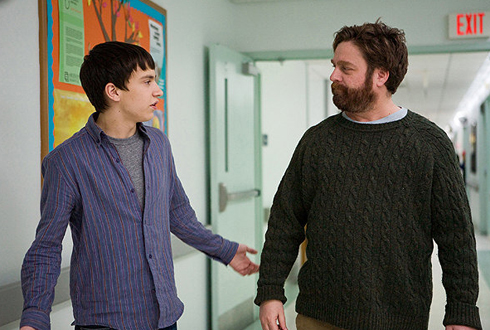
It’s Kind of a Funny Story follows Craig’s five days — the minimum requirement for a designated potential suicide — in the hospital, during which he gets scared, meets a kind psychiatrist (Viola Davis) and makes friends with other troubled patients, including Bobby (Zach Galifianakis of The Hangover). Craig also falls for a pretty girl who happens to be in his coed ward and admits that his life isn’t so bad — just in time.

The film was directed and written by Anna Boden and Ryan Fleck, the team behind the Half Nelson, about the complicated friendship between a junkie teacher and his middle-school student. It’s Kind of a Funny Story is far lighter in tone, more formulaic and easily forgettable. Unlike Half Nelson, a poignant, piercing, in-depth character study, it’s more comedy than a realistic portrait of depression, so there’s never any doubt that things will work out just fine for Craig.

The movie is amusing at times, with the sort of gentle humor that inspires you to smile to yourself rather than guffaw. The filmmakers rely on an array of emo tricks (ironic narration, funky architectural drawings of a city that come to life, an impromptu musical performance of Under Pressure sung by the patients in full glitterwear) for laughs, and the results are more or less positive.

This is a film about depression, though, and it comes awfully close to trivializing its subject by suggesting that all Craig needed, really, was a cute girl to like him back. But the cast is effective enough at reflecting mild irreverence throughout, and the script’s low-key humor keeps the story from becoming unbearably maudlin. It’s Kind of a Funny Story lacks substance, but after you’ve spent a short time in this ward, you have to agree with Craig: These crazies aren’t so bad.

Roger Ebert on Sidney Lumet

Sidney Lumet was one of the finest craftsmen and warmest humanitarians among all film directors. He was not only a great artist but a much-loved man. When the news of his death at 86 arrived on Saturday, it came as a shock, because he had continued so long to be so productive.

Of his final film, Before the Devil Knows You’re Dead (2007), I wrote: “This is a movie, I promise you, that grabs you and won’t let you think of anything else. It’s wonderful when a director like Lumet wins a Lifetime Achievement Oscar at 80, and three years later makes one of his greatest achievements.” Like many of his films, it went on my list of the year’s ten best.

Although he was not as widely known to the public as directors like Scorsese, Spielberg, Eastwood and Spike Lee, his films were at the center of our collective memories. To name only a few of their titles is to suggest the measure of his gift: Network. Dog Day Afternoon. 12 Angry Men. Serpico. Prince of the City. The Pawnbroker. Fail-Safe. Long Day’s Journey into Night. The Verdict.

Most of his fims were set in his native New York City. Although he was nominated four times as best director, he never won an Academy award until his honorary Oscar; that may have been partly because he was not part of the Hollywood community but preferred a milieu he understood inside-out.

He was a thoughtful director, who gathered the best collaborators he could find and channeled their resources into a focused vision. He shared his thoughts about that in his 1996 book Making Movies. If you care to read only one book about the steps in the making of a film, make it that one. There is not a boast in it, not a word of idle puffery. It is all about the work.

To say he lacked a noticeable visual style is a compliment. He reduced every scene to its necessary elements, and filmed them, he liked to say, “invisibly.” You should not be thinking about the camera. He wanted you to think about the characters and the story.

Sidney Lumet was born June 24, 1924, in Philadelphia, the son of Polish immigrants who were actors in the Yiddish theater. The boy was onstage from his earliest years. After service in World War Two, he began to direct in small New York companies and then moved in on the ground floor in the new medium of television.

Lumet, like such contemporaries as Arthur Penn and John Frankenheimer, was a key director in the golden age of live TV drama. He was an early director for Edward R. Murrow’s You Are There. His first feature was 12 Angry Men, considered the best of all filmed dramas about a criminal trial. It had a visual style (he slowly lowered the POV of view as tension increased), but, typically, audiences were not aware of it.

In 1962 he filmed a historic adaptation of Eugene O’Neill’s Long Day’s Journey into Night, and in 1964 launched Rod Steiger’s movie career with The Pawnbroker. Film followed film, many of them based on ethical issues, although he preferred to deeply embody his messages instead of stating them obviously.

Other strong films followed. In addition to his most famous titles, these had my special admiration: Daniel, Power, Q&A, Critical Care and Gloria. He remained remarkably youthful, and in 2006 was able to see the serious dramatic potential of Vin Diesel, dismissed as an action star, and use it for a remarkable performance in Find Me Guilty, the story of a Mafioso trial.

Lumet was married four times, to the actress Rita Gam; the heiress Gloria Vanderbilt; Gail Jones, daughter of Lena Horne; and, in 1980, to Mary Gimbel, who survives him. He is also survived by Amy and Jenny Lumet, his daughters by Miss Jones; a stepson, Bailey Gimbel; nine grandchildren and a great grandson. Jenny Lumet went into the family business, as an actress and the author of the award-winning screenplay for Jonathan Demme’s Rachel Getting Married (2008).

The cause of death, his wife said, was lymphoma. The tears shed at his memorial services will be genuine.
© copyright 2011, rogerebert.com

Goodnight Sidney

Sidney Lumet, one of the great directors in the history of American cinema, died this morning of lymphoma. He was 86.

What George Cukor was for actresses, Lumet was for actors, as this video proves. But pay careful attention to the issues addressed in these films — and others he directed like them, including Serpico, The Verdict and his final masterpiece, Before the Devil Knows You’re Dead. Lumet was not afraid to make movies that dealt with prejudice, corruption and betrayal.

“While the goal of all movies is to entertain,” Lumet once wrote, “the kind of film in which I believe goes one step further. It compels the spectator to examine one facet or another of his own conscience. It stimulates thought and sets the mental juices flowing.”

Film historian Stephen Bowles wrote: “Lumet’s protagonists tend to be isolated, unexceptional men who oppose a group or institution. Whether the protagonist is a member of a jury or party to a bungled robbery, he follows his instincts and intuition in an effort to find solutions. Lumet’s most important criterion is not whether the actions of these men are right or wrong but whether the actions are genuine. If these actions are justified by the individual’s conscience, this gives his heroes uncommon strength and courage to endure the pressures, abuses, and injustices of others. Frank Serpico, for example, is the quintessential Lumet hero in his defiance of peer group authority and the assertion of his own code of moral values.”

Lumet preferred to shoot his films in New York City and I’m convinced his shunning of Hollywood is the main reason he never received an Academy Award for any of his films, although he was nominated four times. In 2005, however, he was awarded a Lifetime Achievement Oscar for his “brilliant services to screenwriters, performers, and the art of the motion picture.” In a 2007 interview in New York magazine, Lumet said “In L.A., there’s no streets! No sense of a neighborhood! They talk about us not knowing who lives in the same apartment complex as us — bullshit! I know who lives in my building. In L.A., how much can you really find out about anybody else? ... Really, it’s just about human contact. It seems to me that our greatest problems today are coming out of the increasing isolation of people, everywhere.”
 
Here’s my list of the 20-best Lumet-directed films:
1. Network (1976)
2. 12 Angry Men (1957)
3. Dog Day Afternoon (1976)
4. The Verdict (1982)
5. Before the Devil Knows You’re Dead (2007)
6. The Pawnbroker (1965)
7. Fail-Safe (1964)
8. Murder on the Orient Express (1974)
9. The Hill (1965)
10. Long Day’s Journey Into Night (1962)
11. Serpico (1973)
12. Running on Empty (1988)
13. The Group (1966)
14. Prince of the City (1981)
15. Equus (1977)
16. Daniel (1983)
17. The Anderson Tapes (1971)
18. Q&A (1990)
19. The Morning After (1986)
20. Deathtrap (1982)

Available on DVD: “Get Low”

Get Low, the first feature directed by Aaron Schneider, is based on one of those true stories that seem indistinguishable from legend. In the late 1930s a man from East Tennessee named Felix Breazeale decided to give himself a funeral before he was even dead. It was, by all accounts, a lively affair, with musical entertainment and a raffle to attract the public, and it left behind a vapor trail of mystery. Who was this character? What was he thinking?

The film’s answer to the second question is a bit unsatisfying, which is forgivable since its answer to the first question is Robert Duvall. This means that though the story sometimes wanders into hazy, corny sentiment, its protagonist (called Felix Bush, which was apparently a nickname or alias of Breazeale’s) is vivid, enigmatic and unpredictable. Duvall, now 80, has recently specialized in small, indelible character parts: the police department patriarch in We Own the Night; the blind survivor speaking in apocalyptic riddles in The Road; the sobered-up bar owner helping Jeff Bridges’s Bad Blake through Crazy Heart.

These contained, welcome appearances are reminders that this actor has gone nearly 50 years in movies virtually without a false note. And Get Low, giving him time and room to explore the crevices of a wily, wounded soul, proves that Duvall is still able to carry a movie easily and gracefully.

It is a lesser movie than The Apostle (1997), which he wrote and directed and which remains on of the most astute screen treatments of American religion and the American South. But Felix Bush shows an unmistakable kinship with the Apostle E.F., the wayward holy man he played in that earlier film. Duvall is too rough, too strange, too capable of surprising himself and everyone around him to be any kind of type.

Unlike E.F, a man of fleshly appetites and spiritual convictions, Felix is cussedly secular and stubbornly monastic. He lives alone in a house in the woods on the edge of town, keeping his neighbors at a distance and the whole county on edge. For company he has a mule, a shotgun, a few dozen jars of home-brewed herbal medicine and a faded photograph of a woman he once loved and lost.

News of an old acquaintance’s death — delivered by a nervous local pastor (Gerald McRaney) — puts Felix in mind of last things. So he heads into town with a big wad of “hermit money,” hoping to purchase pre-emptive last rites. He finds a taker in Frank Quinn (Bill Murray), a transplanted Chicagoan who runs a funeral parlor. Frank and Buddy (Lucas Black), his earnest young assistant, serve as chauffeurs, fashion consultants and event promoters for their client, who rewards them with suspicion, grouchiness, and an occasional burst of rustic humor.

The prospect of death brings Felix back into the life of the town, which had grown accustomed to seeing him as a kind of bogeyman. He renews a long-dormant acquaintance with Mattie (Sissy Spacek), an old friend and also, it seems, an old flame. His only other meaningful connection from his previous life is with a preacher (Bill Cobbs) who lives in Illinois and who refuses Felix’s initial request that he lead the unorthodox funeral service.

As Get Low meanders toward its resolution, sign posts appear pointing in a familiar direction: toward the revelation and redemption of a long-buried tragedy. Felix, we suspect, will at last be explained, accepted and absolved. When this happens, it is something of a letdown, but that is partly because the film is for the most part so richly and comfortably human that it hardly needs the melodramatic amplification of its end.

The deepest pleasure of Get Low, which was written by Chris Provenzano and C. Gaby Mitchell, comes from watching the players play. Spacek enlivens her sweet, quiet role with a necessary dash of vinegar. Murray, impish as ever, keeps the full range of Frank’s motives and feelings tucked up his sleeve. He is greedy, a little shady and basically decent, but the precise balance of these qualities remains in some doubt right up to the end.

The compound of grief, resilience and ornery meanness that defines Felix is even more volatile. Buddy, who becomes Felix’s full-time chauffeur and part-time sidekick, can never tell if, at any given moment, his prize client will show rage, charm, sorrow or plain old backwoods American weirdness.

More of that last trait would have helped Get Low rise above its limitations. But it may be that the full measure of the real Felix Breazeale’s life cannot be taken by a movie that stays safely within currently dominant conventions of storytelling and that wraps unruly material into a tidy narrative package. But if Get Low is, in the end, not quite believable, Duvall’s performance is the opposite.

Friday, April 8, 2011

Grampires

This you gotta see. Of course it's all one big lark, but while I would never fork over any of the hard-earned to see a Twilight movie, I might just take this one in, if it ever got made. Not only that, I think the world is ready for a When Harry Met Sally sequel especially if it was this over-the-top.

Thursday, April 7, 2011

Available on DVD: “Fish Tank”

At first the title of Fish Tank is obscure, relating as it does to a 15-year-old’s coming of age in England rather than a literal aquarium.

But as this tough, mesmerizing film takes hold, the metaphor makes itself clear, from director Andrea Arnold’s boxlike framing to the impassive but compassionate way she watches her characters swim in their own murky psychological waters.

Teenage Mia (Katie Jarvis) lives with her little sister and her single mother, Joanne (Kierston Wareing), in a drab housing project in Essex; as Fish Tank opens, Mia is in the midst of an argument with her best friend, fighting with her mom and getting away from her troubles by dancing alone in an abandoned flat. Taking a British realist cue from Ken Loach (Wareing coincidentally made her astonishing debut in Loach’s It’s a Free World), Arnold films the lives of her subjects with fierce, up-close urgency. But Arnold injects her own lyrical touches in Fish Tank that make it more poetic than most films of the miserabilist school: amid a gray post-industrial wasteland Mia may come upon a lone horse, for example, or take a wild digression into a lowland worthy of Thomas Hardy.

The plot of Fish Tank takes off when Mia’s mum brings home an attractive lover named Connor, played by Michael Fassbender with quiet, seductive guilelessness. (Most recently seen in Inglourious Basterds, Fassbender delivered his own breathtaking breakout performance as Bobby Sands in Hunger.) Connor, it seems, might finally give Mia the protection and support she has clearly been missing most of her life.

In many ways Fish Tank joins An Education and Precious as an acute, empathic portrait of a girl growing up, but more than those films Arnold leaves viewers with a feeling of unsettled ambiguity.

Jarvis, whom the director reportedly discovered at an Essex train station, is nothing less than a revelation in a performance that is tender, spiky and utterly fearless in its physical and emotional range.

For your listening and viewing pleasure

Let’s face it. Life isn’t always easy and sometimes there are no other alternatives but to just hang in there. Patty Griffin nails those feelings and more right here.

The resurrection of Ann-Margaret

First she was the major attraction at the still-in-progress Dallas Whateverit’scalled Film Festival and now Ann-Margaret will join Bobby Rydell in an onstage discussion of the film Bye Bye Birdie April 27 at the Samuel Goldwyn Theater in Hollywood. I would love to attend this event. First I would like to see if Bobby Rydell can really "discuss" anything in semi-literate fashion. But the real reason is a digital restoration of the 1963 musical will be shown prior to the discussion. I know Ann-Margaret got an Oscar nomination for Carnal Knowledge, Dick Van Dyke was wonderful in Mary Poppins and Chitty Chitty Bang Bang and Janet Leigh will always be known for the shower she didn’t get to finish, yet none of them ever were ever  better on-screen than they were in this film. Plus there’s that great simulated gang-bang scene.

Wednesday, April 6, 2011

The 101 Best Screenplays

Have you ever noticed that plays are the property of playwrights, while motion pictures are the property of their directors? So it’s going to be Tony Kushner’s Angels in America, but Steven Spielberg’s Munich (Kushner wrote the Munich screenplay with Eric Roth). I bring this up because I’m guessing the Writer’s Guild of America is tired of all that and that’s one of the main reasons it polled its membership to come up with the 101 Best Screenplays of all time. Truth in advertising: It’s a pretty good list. I have no complaints with it at first glance. Take a look and judge for yourself.

Dear candidate Kunkle: We are not overtaxed and underserved by the city (but maybe by DISD)

Had a form letter from mayoral candidate David Kunkle in my mail box when I got home last night in which he said “My motto of this campaign has been: We are overtaxed and underserved.” I hate to tell the former police chief this, but for the majority of Dallas citizens that is simply not true.

We pay taxes to the city in a variety of ways but the two main ones are through sales and property taxes. One percent of all sales tax-eligible dollars consumers spend within the Dallas city limits goes into the city’s coffers. There are two things to remember about property taxes. The first is only about 25 percent of the total property taxes a homeowner pays goes to the city. About an equal amount goes to the county. The other 50 percent goes to the Dallas Independent School District. So, if you think your are overtaxed and underserved, it’s because you pay a lot in property taxes and don’t have a child attending Dallas public schools.

For years, we have sent misguided souls to the Dallas School Board who thought “things” were far more important than students. So money was poured into building new facilities while families fled to the suburbs or enrolled their students in private schools. Now we are paying for those mistakes because the current budget shortfall is forcing DISD to layoff teachers so it has enough money to pay the debt on all those capital projects. When was the last time you heard of a school board candidate run on a platform of “overtaxed and underserved”? No, it’s all about improving the quality of education which they think means “build another school,” which only serves to raise your property taxes even more.

But the last I heard the overwhelming majority of Dallas residents pay no property taxes directly at all because they are not property owners. More Dallas residents live in rented apartments than own single family homes. I have queried the Dallas Apartment Association for updated statistics and as soon as I receive them I will pass them on.

Until the city can find a way to levy some form of a rental tax that’s on a parity with what nearby property owners pay in property taxes, than you can’t argue that Dallas residents are overtaxed and underserved, especially at the city level.

UPDATE ON APRIL 13: I finally got the figures I was looking for. According to Gene Kriska, director of member/information services for the Dallas Apartment Association, 53 percent of the Dallas population lives in rental units and thus directly pays no property taxes.

The election bombshell

Larry Casto, one of Dallas’ assistant city attorneys, just completed what could have been a mundane presentation to the Dallas City Council on what’s going on with the Lege down in Austin. The reason it wasn’t mundane was because of the “oh, by the way” bombshell he dropped at the end of his presentation. He told the council that the Lege will pass and the governor likely will sign a bill creating a uniform election date throughout the state.

That means is all elections — whether they be school board, municipal, bond elections, congressional, presidential — will be held on the same date and that date probably will be the second Tuesday in November. Therefore, those elected to the City Council this May will not have to stand for re-election until November 2013 (in case of the mayor, November 2015).

This has far reaching effects. For one, like Casto told the council, instead of leading off the ballot like they will in May, city council candidates will probably be relegated to Page 14, 15 or later on the November ballot. But, although this subject wasn’t broached at the council session, I’m guessing this will also eliminate runoffs — that all a council candidate will need is a plurality, not a majority, of the votes. This will definitely favor incumbents, especially if they have more than one opponent in an election because all the opposition voters won’t have the opportunity to unite behind one candidate in a runoff. It also favors minorities in the mayor’s race, especially if the minority community can unite behind and come to the polls to vote for one candidate, which is far more likely to happen in a November election setting.

Unless, of course, the City Council takes the bold step (But when have you ever heard of our council taking a bold step?) of removing the bi-partisan status of the City Council elections. Force the candidates to affiliate with a political party. That way the candidates can run in their respective party’s primary prior to the general election, and the also-rans can be eliminated through that process.

As a semi-closeted anarchist, I love it when something comes along to disrupt the status quo and this is definitely one of those times. Those who are familiar with what really happened in the “location debate” will know if a uniform election date had been created a decade ago, the new Cowboys Stadium probably would have been constructed in Dallas.

The Best of Woody Allen

My intrepid South Florida correspondent tipped me to the fact that Slate, the on-line magazine, is running a poll on the five best and worst Woody Allen films ever made. Those selected as the five best are 1. Annie Hall, 2. Manhattan, 3. Hannah and Her Sisters, 4. Crimes and Misdemeanors and 5. Sleeper. Slate got the first four correct, but as everyone knows, Allen’s fifth best is Bullets Over Broadway. Why waste time discussing anyone’s "worst" films?

Little things that have been on my mind of late

  • If I never hear the word “ap” again it will be too soon.
  • The movie Your Highness features an Academy Award winner (Natalie Portman), an Oscar nominee (James Franco) and, judging from the TV trailers, might rank right up there with Freddy Got Fingered as one of the worst comedies of all times.
  • If the Mavs lose in the first round of the playoffs again, Rick Carlisle has got to go. Let’s see, Jerry Sloan is out there unemployed; so is Larry Brown.
  • I’m really leaning to “None of the Above” in the Dallas mayor’s race.
  • I don’t want to deal with a company that is going to provide me with a “solution” when it hasn’t even heard the problem.
  • The NCAA basketball championship game was a disaster of a game, featuring a pair of teams that had no right to be there in the first place. People are still arguing whether it was Connecticut’s defense or Butler’s ineptitude on offense that resulted in the Bulldogs’ 19 percent field goal percentage for the game. The answer is both: Connecticut’s defense kept Butler on the perimeter, from where they could not hit on open looks. What a mess!
  • Yes, I am excited about the Rangers’ 5-0 start.
  • How about dem Aggies? I am true University of Texas loyalist, but I always root for teams in our conference to do well once the Horns are out of the running. The two teams in the men’s championship game combined to score 94 points, while A&M and Notre Dame accounted for 146 in their title contest. The Aggies’ Danielle Adams scored more points in the second half than Butler did.
  • The proposed undergound pipeline designed to transport oil from the Alberta tar sands to Texas is an environmental disaster wating to happen and should be nipped in the bud immediately. Of course, what greedy oil companies are doing in the Alberta tar sands is an environmental disaster that has already happened.
  • Has anybody else had problems with TimeWarner's crappy internet service lately? When I can get on the internet, it won't give me access to my e-mail.

Tuesday, April 5, 2011

Available on DVD: “Tamara Drewe”

No one combines literature and sex like the British. All that class repression makes for good healthy shagging, as the urge for proper wordplay wars with barnyard desire and almost always loses. The airy country comedy Tamara Drewe gets right into the ruts and starts mucking about, and if the movie doesn’t add up to much, it may be because modern audiences and filmmakers alike aren’t sure what to do with a perfectly nice heroine who does fancy a screw.

The movie stars Gemma Arterton, a young British actress who has survived overblown Hollywood fantasies like Clash of the Titans and Prince of Persia: The Sands of Time — at the very least, she deserves a stay-at-home vacation. Her character, Tamara Drewe, arrives back in her childhood Dorset hamlet of Ewedown with a new nose, a suitcase full of short-shorts, and a glamorous career as a London newspaper columnist. Across the fields from her family home is Stonefield, a writer’s retreat full of tweedy authors and would-be authors — an excellent ant colony for Tamara to stir up.

Stonefield is owned by Nicholas (Roger Allam), an imperious and very successful writer of detective fiction; his wife Beth (Tamsin Greig) keeps the place running and passive-aggressively ignores her husband’s womanizing. The retreat’s caretaker, Andy (Luke Evans), is a strapping hunk of Dorset beef whose family once owned Tamara’s manse and who studiously tries to ignore the teenage fling the two had back when her nose was immense.

Other characters mill genially about: An American academic (Bill Camp) blocked on his Thomas Hardy biography and nursing a crush on Beth; a sneering British rock star (Dominic Cooper) happy to be Tamara’s latest boy toy; two teen girls, Jody (Jessica Barden) and Casey (Charlotte Christie), who are bored bored BORED and up to no good; a comely pub owner (Josie Taylor); the rocker’s dog. Everyone keeps banging into each other, the farcical complications build, and when director Stephen Frears isn’t sure what to do, he sends cinematographer Ben Davis out to frame breathtaking shots of the countryside. Frears has made everything from My Beautiful Laundrette to High Fidelity to The Queen; this is a vacation for him, too.

The movie’s based on an odd combination of graphic novel and serialized novelette by Posy Simmonds that ran in weekly installments in England’s The Guardian; Simmonds, in turn, based her tale very loosely on Hardy’s Far From the Madding Crowd. The comic’s a tricky work to adapt, and Frears hasn’t entirely pulled it off. It may be that all the bedroom friskiness carries increased moral weight on screen, but Tamara seems more home wrecker than charmer by the final act. Miscasting plays a part, too: Allam is a fine actor who lacks the sexual charisma Nicholas needs if we’re to believe some of the plot twists.

The graphic novel took a climactic turn for the grim that screenwriter Moira Buffini eases back on without eliminating and that furthers the sense of slightly balmy narrative disarray. Not that a comedy shouldn’t deal in darkness, but the shifts in tone that might work in weekly installments play as mere clutter when encountered one after another. Tamara Drewe is a frolic that keeps tripping over its own gorgeous feet.

“Tamara Drewe” trailer

Monday, April 4, 2011

Available on DVD: “Still Walking”

Everybody likes corn tempura. Never had it? Me, neither. But given how little the characters in Still Walking agree on, and how much they all agree on corn tempura, it must have magical properties.

It certainly has the power to make people forget their resentments, and their differences. And the dead son who stalks each tatami-covered room in Japanese director Hirozaku Kore-eda’s understated but utterly spectacular film. As he has proved in the past, Kore-eda has a novelistic approach to storytelling and a puckish approach to death: His poetical debut, Maborosi, was a somber tale about a woman in mourning; After Life was a comedy about people in Heaven.

In his latest, Still Walking, a somewhat typical middle-class Japanese family struggles to maintain a surface domestic tranquillity while roiling — 15 years after the fact — over the death of its eldest son. It’s a comedy of good manners, an elegy for lost potential and a cultural moment caught mid-shift.

It’s also one of the more accomplished and beautiful films I’ve seen so far this year, and further establishes Kore-eda — not quite 50 and one of his country’s great directors — as an artist utterly in control of his medium, one with a watchmaker’s appreciation for synchronized intimacies and mechanical fluency. One fears to blink, because some essential element in the story will be lost and, with it, some nuance, of which there are many.

Kore-eda’s obvious model is Yasujiro Ozu’s celebrated Tokyo Story of 1953, which focused on the Japanese family as the principal seismograph of societal upheaval. On the anniversary of the death of Junpei — who died saving a young boy from drowning — his family gathers for the annual commemoration. The surviving son, Ryo (Hiroshi Abe), reluctantly attends, with his bride and her young son. That Ryo has married a widow displeases his father, a retired doctor of formal mien named Kyohei (Yoshio Harada), who is pleased by very little: He grumbles, he stalks about his house ignoring his guests.

When the young boy whom his son saved shows up to pay his respects — he has grown into an overweight, barely employed young man, clearly oppressed by the weight of Junpei’s death — Kyohei wonders aloud what everyone is thinking: Why did the kid live and his son die? Kyohei is as uncharming in his candidness as one might suggest.

And yet, he’s hardly an alien: His chauvinistic attitude toward women is shared by his son — neither will carry a shopping bag, no matter how weighed down his wife is. And both share the idea that one is defined and validated by one’s work: Kyohei has retired, and thus opted out of usefulness; Ryo, who has lived in the shadow of his brother, is not a success, but can never be one, mostly because he sees himself through his father’s eyes. Kore-eda’s art lies in making all this angst as palatable as corn tempura.

Kore-eda’s use of ironically whimsical and decidedly non-Japanese music, his casting of Abe — who looks distinctly Amer-Asian, and thus Other — and the Westernized attitudes of Kyohei’s children all make a piquant statement about the Americanization of Japan since the war, and the time-honored bonds of family and ritual that dissolved under the pressures of a new world. The figure who closest represents an intractable consistency is the mother, Toshiko (Kirin Kiki), and she’s hardly compliant — she cooks, she serves, she puts up a hospitable front. But when her daughter Chinami (the actress named You) makes plans to move back home with her family, Mom balks. Dad’s enough of a hassle. After a lifetime of tradition and tragedy, Toshiko wants to kick off the straw sandals and relax.

“Still Walking” trailer

Sunday, April 3, 2011

Available on DVD: “Middle Men”

There aren’t many actors who could be counted on to engender sympathy for a character who gets filthy rich by facilitating adult websites, leaves his wife for a 23-year-old sex star and is probably guilty, in at least a strictly legal sense, of distributing child pornography. One who can is Luke Wilson. He’s made a specialty of what might be termed “Andy Travis” roles, after the eminently reasonable station manager forced to deal with ubiquitous goofballs on WKRP in Cincinnati.

In Middle Men, he’s Jack Harris, an entrepreneur who helped to pioneer the anonymous credit card processing that enabled online smut peddlers to thrive. In the process, this buttoned-down family man from Houston ends up mingling with coke-addled programmers (Giovanni Ribisi and Gabriel Macht), a crooked lawyer (James Caan), the aforementioned Audrey Dawns (Laura Ramsey) and, naturally, a murderous Russian mobster (Rade Serbedzija).

It’s an amusing tour of the days when the World Wide Web was more like the Wild West, and its many colorful characters are sharply drawn. Eventually, though, Middle Men succumbs to the limitations of its perspective. Harris’ story is (loosely, one senses) based on that of Christopher Mallick, one of the film’s producers, and it seems as if all the rough edges of the character have been sanded away. What could have been a complex portrait of a flawed man dealing with the perils of success ends up far less interesting.

“Middle Men” trailer

My Top 10 NBA teams

Last week's rank in parenthesis
1.  Los Angeles Lakers, 53-20 (2)
2.  Chicago Bulls, 56-20 (3)
3.  Miami Heat 53-23 (1)
4.  San Antonio Spurs 57-19 (4)
5.  Boston Celtics 52-23 (5)
6.  Orlando Magic 48-28 (6)
7.  Denver Nuggets 46-29 (7)
8.  Dallas Mavericks 53-23 (8)
9.  Oklahoma City Thunder 50-26 (9)
10. Memphis Grizzlies 44-33 (NR)
Dropped out: New Orleans Hornets