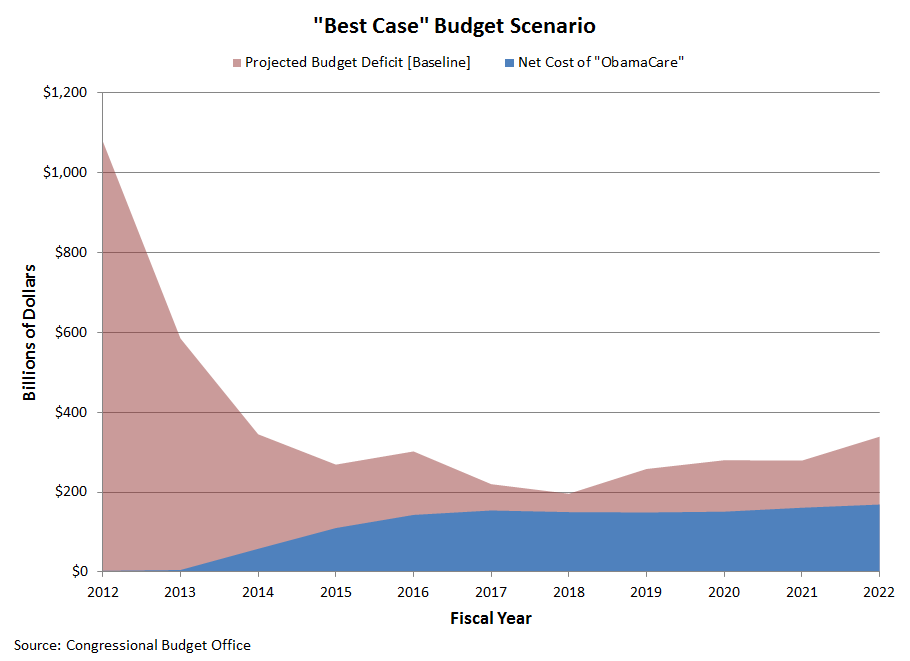
At the top of the front page of today’s Dallas Morning News is the headline "Health law will shrink deficit, budget office says." Like that’s news.
In a stunning example of hyperbole, the first paragraph of the story goes like this:
"President Barach Obama’s health care overhaul will shrink rather than increase the nation’s huge federal deficit over the next decade, Congress’ nonpartisan budget scorekeepers said Tuesday, supporting Obama’s contention in a major election-year dispute with Republicans"
Wake up, News! The Congressional Budget Office has been saying the President’s health care plan would reduce the deficit from the moment the White House proposed it. In fact, if you read past the jump on the News’ story, all the way down to the 10th paragraph, you will find these words:
"The Congressional Budget Office has consistently projected that Obama’s overhaul will reduce the deficit …"
Duh! Then what’s the news value in this story? Maybe it’s just the Morning News that has realized for the first time what the CBO has been saying all along. Now, that’s a scary thought for those who depend on the paper as their primary news source.
Showing posts with label health care reform. Show all posts
Wednesday, July 25, 2012
Friday, June 10, 2011
The cold, hard truth about health care costs
Canada has a single-payer health care system in which the government foots the bill for all medical costs. Great Britain has socialized medicine. That means the government is not only the only insurer, but it also employs all the doctors and nurses and runs all the hospitals. Yet, in spite of that, as measured against our overall economy, the U.S. government pays more in health care costs than either of those two nations. Not only that, the private sector costs are even greater. We spend 16 percent of our gross domestic product in health care. No other country in the world spends more than 12 percent. But there might be a way to remedy this, although it’s definitely not the Republican’s way — they would only make an untenable situation worse.
Sunday, January 16, 2011
Republicans are correct about health insurance premium costs but they won't tell you why
House Republicans hellbent on the meaningless exercise of voting to repeal health care reform base their argument around the notion that repeal would mean lower insurance premiums for most Americans. And they are correct. Repeal would reduce premium costs. What Republicans don't want to tell you is why. The reason is because the insurance would not cover as much as it must under the new health care reform laws and those lucky enough to possess health insurance under the Republicans' plans would pay far more out-of-pocket costs.
Republicans have given up on their claims that repeal won't add $240 trillion to the federal deficit over the next decade, even though the GOP has said its top priority is reducing the deficit. Obviously reducing it is, at best, fifth or sixth on their priorty list, because they are now declaring a mulligan on health care reform repeal saying "So what, we'll try to make it up by cutting other benefits to the poor, middle class and minorities."
Of course, the entire exercise is meaningless anyway. Yes, repeal will pass the House, but it will not pass in the Senate and, even if it did, it would face a certain Presidential veto.
Republicans have given up on their claims that repeal won't add $240 trillion to the federal deficit over the next decade, even though the GOP has said its top priority is reducing the deficit. Obviously reducing it is, at best, fifth or sixth on their priorty list, because they are now declaring a mulligan on health care reform repeal saying "So what, we'll try to make it up by cutting other benefits to the poor, middle class and minorities."
Of course, the entire exercise is meaningless anyway. Yes, repeal will pass the House, but it will not pass in the Senate and, even if it did, it would face a certain Presidential veto.
Sunday, August 22, 2010
The Republican plan for increasing the deficit
This editorial from today's New York Times is a must-read, especially since it involves the nefarious activities of one of Texas's primary Congressional embarrassments:
Republicans claim to be deeply worried about the deficit — their favorite political target, followed closely by President Obama’s relentlessly demonized health care reform. So why are they so determined to overturn one of the central cost-control mechanisms of the new reform law?
Republicans in both the Senate and the House have introduced bills that would eliminate the new Independent Payment Advisory Board, which is supposed to come up with ways to rein in excessive Medicare spending — and stiffen Congress’s spine.
Starting in 2014, whenever Medicare’s projected spending exceeds a target growth rate, the board of 15 members (drawn from a range of backgrounds, appointed by the president and confirmed by the Senate) will have to recommend reductions in payments to doctors and health care providers to bring spending back to target levels. These recommendations would become law unless Congress — not known for its political courage in such circumstances — passed an alternative proposal that would achieve comparable savings.
None of this poses any real threat to Medicare beneficiaries. The law prohibits the board from making proposals that would ration care, increase taxes, change Medicare benefits or eligibility, increase premiums or cost-sharing, or reduce low-income subsidies for drug coverage. It cannot call for a reduction in payments to hospitals before 2020.
If anything, we fear that the board’s power will be too limited. But its power to curb payments to other providers is projected to save $15.5 billion to $24 billion between 2015 and 2019.
That has not stopped Senator John Cornyn of Texas from trying to kill off the board. In July, he introduced the ever so cutely named “Health Care Bureaucrats Elimination Act.” It currently has 11 co-sponsors, and a similar version, introduced earlier in the House by the Republican Phil Roe of Tennessee, has 54 co-sponsors.
Neither bill will go anywhere so long as the Democrats run Congress, but expect to hear a lot of hype about bureaucrats hijacking health care — and nothing about the needed savings — in this fall’s campaign.
Republicans are also eagerly attacking another important source of savings: the new law’s elimination of the subsidies given to the private managed-care plans known as Medicare Advantage. That is projected to save $132 billion over the next decade, but don’t expect to hear about that part on the campaign trail.
Instead, Republicans are warning seniors enrolled in these plans that their coverage may disappear. Senator John Barrasso, Republican of Wyoming, even charged that the cuts would “kill” the Medicare Advantage program, which now serves some 11 million beneficiaries. That is preposterous.
The law simply forces managed-care plans to compete on an even basis with the traditional Medicare program. Some beneficiaries may face higher costs or lose some gold-plated benefits, but only the most inefficient plans will disappear when the unjustified subsidies that are propping them up are withdrawn.
Republicans are also eagerly, and shamefully, pillorying Dr. Donald Berwick, the new head of the Centers for Medicare and Medicaid Services. There are few figures who command greater respect for uniting health professionals and institutions to improve the quality of medical care while reducing costs. That is not stopping these critics from implying — baselessly — that he will introduce socialized medicine and death panels in this country.
The truth is that Dr. Berwick has praised the socialized British health care system, especially for its emphasis on primary care. This country certainly needs to do more to develop its primary care system. And he has, rightly, called for an open discussion of the health care rationing that is already widespread in our system. When insurers decline to cover procedures, or high prices screen out low-income people, that is rationing.
Dr. Berwick has endorsed the use of “comparative effectiveness” research to determine which treatments work best. He would use such research to judge whether a new drug or procedure is worth the cost of coverage, a step the reform law shies away from. He does not have the power to change that law. But the issue will have to be addressed at some point if there is to be any hope of restraining medical spending.
Democrats have to counter the Republicans’ demagoguery with facts. Americans need to understand that if Senator Cornyn and others get their way, runaway health care costs will only get worse.
Democrats should not be shy about touting reform’s benefits — for improving Americans’ lives or its potential for reducing the deficit. They also need to tell Americans that there are even tougher choices to make ahead. Voters may find it refreshing to hear politicians tell them the truth.
Tuesday, March 23, 2010
Once again, Texas Republicans prove they hate their constituents
I guess it should come as no surprise that Republican Attorney General Gregg Abbott of Texas, the state with the highest percentage of uninsured citizens in the nation, announced he would file suit to prevent the new health care reform law from applying to Texans.
That could mean health insurance companies in Texas could continue to raise premiums, deny health care to the sick, blacklist those with pre-existing conditions and force the elderly to pay increasingly higher costs for their prescriptions.
The good news is that most constitutional scholars say the tactic won't work because the law is framed as a tax, which the federal government has the power to create.
That could mean health insurance companies in Texas could continue to raise premiums, deny health care to the sick, blacklist those with pre-existing conditions and force the elderly to pay increasingly higher costs for their prescriptions.
The good news is that most constitutional scholars say the tactic won't work because the law is framed as a tax, which the federal government has the power to create.
Monday, March 22, 2010
Michael Moore's letter to Republicans
This is just too good not to share. It's a letter filmmaker Michael Moore wrote to Republicans telling them, basically, "not to worry - the health care reform package will cover them and their descendents as well." It is a must-read.
America finally catches up to the rest of the civilized world
The United States is the only advanced industrialized nation that fails to provide or guarantee health care coverage for its citizens. The historic legislation passed last night by the House of Representatives and signed into law today by President Obama does not change that completely but it goes a long, long way toward ending this indefensible neglect of the American people. By 2019, between 94 and 95 percent of indivuduals below Medicare age who are legal residents of this country will be covered by health insurance. That is something we should be proud of.
Not only that, insurance companies will no longer be able to reject or charge exorbitant rates to those with "pre-existing conditions." They will no longer be able to stop coverage when a person becomes ill or cap the amount of coverage they will provide during any given year.
Working Americans already covered by employer insurance will see little if any change, except for the fact that they will now be allowed to include their children on their health insurance policies until they reach the age of 26. And, if they lose their jobs, they will not lose the ability to have health insurance - and in this economy that's important.
This landmark legislation should be viewed as a beginning and not an end. It should also be noted that there will be those who will continue to use demagoguery and outright lies to continue to fight it. One of those demagogues was seen outside the Capitol yesterday holding a sign that said "Doctors not dictators." I wonder if this misguided soul knew that the new medical coverage reform law was endorsed by the American Medical Association.
It is my belief that this reform will achieve its goals. But at least we can, despite all the roadblocks placed in front of it, celebrate the fact that we are finally beginning the process of doing the right thing for the American people.
Not only that, insurance companies will no longer be able to reject or charge exorbitant rates to those with "pre-existing conditions." They will no longer be able to stop coverage when a person becomes ill or cap the amount of coverage they will provide during any given year.
Working Americans already covered by employer insurance will see little if any change, except for the fact that they will now be allowed to include their children on their health insurance policies until they reach the age of 26. And, if they lose their jobs, they will not lose the ability to have health insurance - and in this economy that's important.
This landmark legislation should be viewed as a beginning and not an end. It should also be noted that there will be those who will continue to use demagoguery and outright lies to continue to fight it. One of those demagogues was seen outside the Capitol yesterday holding a sign that said "Doctors not dictators." I wonder if this misguided soul knew that the new medical coverage reform law was endorsed by the American Medical Association.
It is my belief that this reform will achieve its goals. But at least we can, despite all the roadblocks placed in front of it, celebrate the fact that we are finally beginning the process of doing the right thing for the American people.
Sunday, March 21, 2010
Rep. Jeb Hensarling is a liar
One of the great lessons of Vietnam was that it taught us that our elected leaders lie to us. But when it came to Vietnam, because the truth was coming from a half a world away, it was easier for political leaders to hide that truth and perpetuate their lies. It's amazing to me, however, that elected officials continue to lie to their constituents when the truth is right there for everyone to see.
And why Republican Rep. Jeb Hensarling of Dallas, someone I once credited with thinking independently, continues to drink his party's ideological kool-aid when everyone with sight knows the man is lying, or can discover for him or herself that he is lying, is just too much to fathom.
But what makes it worse is that if Rep. Hensarling really did testify Saturday before the House Rules Committee - testified under oath, that is - he should be charged with perjury and expelled from the House of Representatives.
I, along with I'm guessing a large number of his constituents, received an e-mail from Hensarling Saturday in which he said "I testified before the House Rules Committee this afternoon because I am trying, even at this late stage in the debate, to stop a government take over of health care."
Anyone who has read the health care reform legislation passed by the Senate and the one that will be passed Sunday in the House knows for a fact that there's is nothing in either bill that remotely resembles what any honest person can call "a government take over a health care." There is not even a public option in either bill. Nada. None. Zero. It doesn't exist. No one will be able to purchase government-run health insurance because it still won't exist for anyone not on Medicare.
But that's not the only lie Hensarling tries to perpetuate. He also writes in his e-mail, "Throughout my career, I have warned about how wasteful Washington spending will force a mountain of debt upon our children and grandchildren. Not only will this legislation decrease the quality of health care in America, it will force us to borrow even more money from the Chinese to pay for it."
Where do I start with all the lies in those two sentences? I guess here is as good a place as any: How can he say "this legislation will decrease the quality of health care." Again, if you actually read the legislation being considered, steps are taken to make sure that the quality of health care increases under this proposal while, at the same time, reducing the cost of that care. What's more, the independent, non-partisan Congressional Budget Office analyzed the bills and said, not only are they revenue neutral, they will actually reduce the deficit. If Hensarling ever decided to stop lying he would, if he really was concerned about "wasteful Washington spending," support this legislation that reduces the deficit while providing the same health insurance Hensarling himself receives by being a member of Congress to millions of other Americans.
I really should be realistic about this. Hensarling doesn't give a damn about "wasteful government spending." (If he did, he would, like I said above, support these bills which reduce the deficit and would have never supported the Bush tax cuts that got us into this massive deficit to begin with.) Hensarling is merely a puppet and the insurance companies, which oppose any legislation that forces them to act compassionately and actually compels them to provide what they are selling, are pulling his strings. If he was honest, he would come out and admit this but, as the facts reveal, Hensarling is a liar.
And why Republican Rep. Jeb Hensarling of Dallas, someone I once credited with thinking independently, continues to drink his party's ideological kool-aid when everyone with sight knows the man is lying, or can discover for him or herself that he is lying, is just too much to fathom.
But what makes it worse is that if Rep. Hensarling really did testify Saturday before the House Rules Committee - testified under oath, that is - he should be charged with perjury and expelled from the House of Representatives.
I, along with I'm guessing a large number of his constituents, received an e-mail from Hensarling Saturday in which he said "I testified before the House Rules Committee this afternoon because I am trying, even at this late stage in the debate, to stop a government take over of health care."
Anyone who has read the health care reform legislation passed by the Senate and the one that will be passed Sunday in the House knows for a fact that there's is nothing in either bill that remotely resembles what any honest person can call "a government take over a health care." There is not even a public option in either bill. Nada. None. Zero. It doesn't exist. No one will be able to purchase government-run health insurance because it still won't exist for anyone not on Medicare.
But that's not the only lie Hensarling tries to perpetuate. He also writes in his e-mail, "Throughout my career, I have warned about how wasteful Washington spending will force a mountain of debt upon our children and grandchildren. Not only will this legislation decrease the quality of health care in America, it will force us to borrow even more money from the Chinese to pay for it."
Where do I start with all the lies in those two sentences? I guess here is as good a place as any: How can he say "this legislation will decrease the quality of health care." Again, if you actually read the legislation being considered, steps are taken to make sure that the quality of health care increases under this proposal while, at the same time, reducing the cost of that care. What's more, the independent, non-partisan Congressional Budget Office analyzed the bills and said, not only are they revenue neutral, they will actually reduce the deficit. If Hensarling ever decided to stop lying he would, if he really was concerned about "wasteful Washington spending," support this legislation that reduces the deficit while providing the same health insurance Hensarling himself receives by being a member of Congress to millions of other Americans.
I really should be realistic about this. Hensarling doesn't give a damn about "wasteful government spending." (If he did, he would, like I said above, support these bills which reduce the deficit and would have never supported the Bush tax cuts that got us into this massive deficit to begin with.) Hensarling is merely a puppet and the insurance companies, which oppose any legislation that forces them to act compassionately and actually compels them to provide what they are selling, are pulling his strings. If he was honest, he would come out and admit this but, as the facts reveal, Hensarling is a liar.
Sunday, February 14, 2010
Small ideas won't fix our health care crisis or reduce the deficit
Here's another in a series of superb commentaries offered by The New York Times on the need for health care reform. In part, the story says:
"When Republican Congressional leaders come to the White House’s health care summit meeting on Feb. 25, don’t expect them to bring any big ideas with them. Instead, they will press President Obama to scrap his ambitious health care reforms and focus on modest proposals. That may make political sense. Americans have certainly been spooked by all of the Republican hype about government takeovers. But the small ideas the Republicans are championing would barely make a dent in the most critical problems threatening the health care system: the huge number of Americans without insurance and the ever-escalating costs of health care."
The story then goes on to say that many of the Republicans' ideas have merit, but "they are not enough to fix the broken health care system. ... the Congressional Budget Office judged that a bill championed by House Republicans would leave some 17 percent of all legal non-elderly residents without coverage in 2019 — the same percentage as now. The Democratic bills passed by the House and the Senate would leave only 4 to 6 percent uninsured."
The story then lists "the main 'fixes' contained in Republican reform bills. It is well worth taking the time to read the entire piece.
"When Republican Congressional leaders come to the White House’s health care summit meeting on Feb. 25, don’t expect them to bring any big ideas with them. Instead, they will press President Obama to scrap his ambitious health care reforms and focus on modest proposals. That may make political sense. Americans have certainly been spooked by all of the Republican hype about government takeovers. But the small ideas the Republicans are championing would barely make a dent in the most critical problems threatening the health care system: the huge number of Americans without insurance and the ever-escalating costs of health care."
The story then goes on to say that many of the Republicans' ideas have merit, but "they are not enough to fix the broken health care system. ... the Congressional Budget Office judged that a bill championed by House Republicans would leave some 17 percent of all legal non-elderly residents without coverage in 2019 — the same percentage as now. The Democratic bills passed by the House and the Senate would leave only 4 to 6 percent uninsured."
The story then lists "the main 'fixes' contained in Republican reform bills. It is well worth taking the time to read the entire piece.
Wednesday, January 20, 2010
President Obama's wakeup call

The election of Scott Brown, a Republican in the most Democratic state in the Union, as the new U.S. senator from Massachusetts, should serve as a wake-up call to President Obama -- a warning that he needs to shift his emphasis.
The issue in Massachusetts was not health care reform and don't be persuaded by those who said Brown's victory was because he promised he would vote against the health care reform legislation in Congress. This election was a case of the voters of Massachusetts sending a message to the President of the United States that his focus should not be on health care reform, but on job creation. Health care reform is necessary, but it doesn't do anyone any good if they feel they can't take advantage of it.
I am convinced most Americans think there are only one of two ways they can purchase health insurance, no matter how "affordable" that insurance might be. The first way is that it is offered by an employer; the second is that they purchase insurance on their own. Both ways, Americans feel, require an income and that usually means a job.
The previous administration inherited a healthy economy and destroyed it. What makes matters worse is that the economic policies professed by Sen.-elect Brown and other Republicans would guarantee further economic deterioration. So now, President Obama doesn't have the 60 votes needed to prevent Republican filibustering on health care. Fine. Then put that on the back burner for now (especially since the health care reform legislation currently being debated is so watered down it's not worth fighting for anyway) and focus the administration's efforts on job creation and force Brown and his cohorts to oppose that.
The issue in Massachusetts was not health care reform and don't be persuaded by those who said Brown's victory was because he promised he would vote against the health care reform legislation in Congress. This election was a case of the voters of Massachusetts sending a message to the President of the United States that his focus should not be on health care reform, but on job creation. Health care reform is necessary, but it doesn't do anyone any good if they feel they can't take advantage of it.
I am convinced most Americans think there are only one of two ways they can purchase health insurance, no matter how "affordable" that insurance might be. The first way is that it is offered by an employer; the second is that they purchase insurance on their own. Both ways, Americans feel, require an income and that usually means a job.
The previous administration inherited a healthy economy and destroyed it. What makes matters worse is that the economic policies professed by Sen.-elect Brown and other Republicans would guarantee further economic deterioration. So now, President Obama doesn't have the 60 votes needed to prevent Republican filibustering on health care. Fine. Then put that on the back burner for now (especially since the health care reform legislation currently being debated is so watered down it's not worth fighting for anyway) and focus the administration's efforts on job creation and force Brown and his cohorts to oppose that.
Wednesday, December 30, 2009
The urgent need for health care reform
Should Congress pass health care reform legislation? Readers of this blog know where I stand on the subject: the No. 1 priority of any government is protecting their citizens and that includes protecting them from sickness. Here's another credible source making a sound case for passage of health care reform legislation. My favorite paragraph from the article is:
"The fact that 46 million people in this country have no health insurance should be intolerable. Every other major industrial country guarantees health coverage to its citizens, yet the United States, the richest of them all, does not."
Here's another paragraph from the story that needs to be highlighted:
"The American Cancer Society now says the greatest obstacle to reducing cancer deaths is lack of health insurance. It is so persuaded of that fact that two years ago, instead of promoting its antismoking campaign or publicizing the need for cancer screening, it devoted its entire advertising budget (emphasis mine) to the problem of inadequate health insurance coverage."
"The fact that 46 million people in this country have no health insurance should be intolerable. Every other major industrial country guarantees health coverage to its citizens, yet the United States, the richest of them all, does not."
Here's another paragraph from the story that needs to be highlighted:
"The American Cancer Society now says the greatest obstacle to reducing cancer deaths is lack of health insurance. It is so persuaded of that fact that two years ago, instead of promoting its antismoking campaign or publicizing the need for cancer screening, it devoted its entire advertising budget (emphasis mine) to the problem of inadequate health insurance coverage."
Tuesday, December 15, 2009
Trying to find the bright side while dancing on the dark side of the moon
About the only positive side of the Supremes stealing the 2000 presidential election for George W. is the fact that this jerk never became vice president. True, he might not have been as dangerous as Dick Cheney, but he could have wielded even far more influence today. I'm thinking, however, the voters of Connecticut aren't going to stand for his flip-flopping on health care reform and will vote him out of office the next time he's up for re-election, which, unfortunately, is still three years away. In fact, Jim Shea, a columnist for the Hartford Courant, wrote recently: “If you think you are sick of Joe Lieberman now, just wait until you get sick.” A poll conducted by Quinnipiac College showed a majority of Connecticut voters favored a public option plan in any health care reform legislation.
According to the above-linked story in the New York Times, Senate Democrats can't understand why Lieberman wants to scuttle President Obama's health care reform initiatives. Hell, the answer is simple. His wife, Hadassah, is an unpaid lobbyist for a number of pharmaceutical and insurance companies and she previously worked in public relations for two pharmaceutical companies. Plus, during his 2006 re-election campaign, Mr. Lieberman ranked second in the Senate in insurance industry contributions. He has received more than $1 million insurance company campaign contributions since 1998.
What's interesting about all this is that when he was Gore's running mate in 2000 he advocated a public option in health care reform and even suggested a Medicare buy in for people who are 55 and older, two plans he now says need to be scrapped from the current legislation before he will support it.
Update: The New York Times has an excellent editorial on Liberman's flip-flopping in its Wednesday edition.
According to the above-linked story in the New York Times, Senate Democrats can't understand why Lieberman wants to scuttle President Obama's health care reform initiatives. Hell, the answer is simple. His wife, Hadassah, is an unpaid lobbyist for a number of pharmaceutical and insurance companies and she previously worked in public relations for two pharmaceutical companies. Plus, during his 2006 re-election campaign, Mr. Lieberman ranked second in the Senate in insurance industry contributions. He has received more than $1 million insurance company campaign contributions since 1998.
What's interesting about all this is that when he was Gore's running mate in 2000 he advocated a public option in health care reform and even suggested a Medicare buy in for people who are 55 and older, two plans he now says need to be scrapped from the current legislation before he will support it.
Update: The New York Times has an excellent editorial on Liberman's flip-flopping in its Wednesday edition.
Monday, December 14, 2009
Thoughts about the pending health care reform legislation
A number of my colleagues are incensed that the current health care reform bill pending in the Senate doesn't contain a strong public option. Me? I'm more of a half-a-loaf-is-better-than-none type of guy. Let's get a reform bill out of Congress and signed by the President. Once that door is opened, future lawmakers can work on perfecting it.
Look, there's 46 million Americans walking around today without health insurance. Millions more have such poor insurance that any kind of sickness will take them into bankruptcy. Too many small businesses that once provided health insurance to their employees can no longer afford it. Those that have insurance have probably had to deal with higher premiums, increased co-payments and less coverage. The research group Commonwealth Fund estimates in 10 years the average health insurance policy for an employed worker will cost $23,800 by the year 2020. Sure, some of that will be paid by employers, but ... And what about those who have to buy their health insurance directly?
And, yes, there are problems with the current legislation, in addition to the absence of a meaningful public option. Another is the reduced payments for Medicare recipients. I would also like to see provisions in there that allow the importation of cheaper drugs. But one thing it won't do -- and too many Republicans are telling outright lies about this fact: It won't increase the deficit. The legislation contains provisions that will not only pay the full cost of the reform, but actually reduce our deficit, although, admittedly, not by a whole lot. The Congressional Budget Office estimates the reduction to be between $130 billion and $650 billion during the next 10 years.
I find it disingenuous, however, that the same Republican lawmakers who wanted to extend former President Bush's tax breaks to the wealthy, tax breaks that added $4 trillion to the deficit, are now claiming we cannot afford health care reform.
So even though it could do more, the time has long passed to do something for those 46 uninsured Americans.
Look, there's 46 million Americans walking around today without health insurance. Millions more have such poor insurance that any kind of sickness will take them into bankruptcy. Too many small businesses that once provided health insurance to their employees can no longer afford it. Those that have insurance have probably had to deal with higher premiums, increased co-payments and less coverage. The research group Commonwealth Fund estimates in 10 years the average health insurance policy for an employed worker will cost $23,800 by the year 2020. Sure, some of that will be paid by employers, but ... And what about those who have to buy their health insurance directly?
And, yes, there are problems with the current legislation, in addition to the absence of a meaningful public option. Another is the reduced payments for Medicare recipients. I would also like to see provisions in there that allow the importation of cheaper drugs. But one thing it won't do -- and too many Republicans are telling outright lies about this fact: It won't increase the deficit. The legislation contains provisions that will not only pay the full cost of the reform, but actually reduce our deficit, although, admittedly, not by a whole lot. The Congressional Budget Office estimates the reduction to be between $130 billion and $650 billion during the next 10 years.
I find it disingenuous, however, that the same Republican lawmakers who wanted to extend former President Bush's tax breaks to the wealthy, tax breaks that added $4 trillion to the deficit, are now claiming we cannot afford health care reform.
So even though it could do more, the time has long passed to do something for those 46 uninsured Americans.
Friday, October 30, 2009
Senate should model its health care reform bill on House's version

The House of Representatives has introduced a health care reform bill that accomplishes what this legislation is supposed to do -- greatly reduce the number of uninsured while reducing budget deficits. It includes a public option, but not one as strong as I would like --i.e., the option plan doesn't pay doctors and hospitals based on Medicare rates -- but at least one is in there. The problem with it is the public option probably will cost more than the average private plan because it might only attract the sickest people.
Still, it's far superior to the Senate plan. The bill would generate enough taxes (the chief one being a surcharge on the part of annual income exceeding $1 million for couples and $.5 million for individuals -- after all the tax breaks that benefited the wealthy during the Bush administration it's fitting they pay a heavy share of health care reform) and Medicare savings so that the net effect of the bill would be to reduce the deficit by $104 million over the next 10 years.
It requires employers, except for small businesses, to either offer health care benefits to their employees and pay a large portion of the cost of that care, or face a severe penalty. By the year 2019, it is expected this bill would provide health insurance to 96 percent of all Americans who are not elderly and living here legally. It would allow young people up to the age of 26 to remain on their parents' policies. It would provide immediate help to those who have been denied insurance because of pre-existing conditions.
The Senate should come up with a bill as fiscally responsible and one that gets as close to universal coverage as this one.
Tuesday, October 27, 2009
Don't worry about Texas opting out ... yet
The current Senate version of the health care reform package contains a public option as well as a mechanism for states, like Texas, which has a history of denying its citizens adequate health care protections, to opt out of the public option.
There's no question that a majority of Texas political leaders are in bed with the insurance companies. (It should also be noted that many of these same hacks -- I'm trying to discover exactly how many -- are on Medicare, meaning they are denying their constituents the same kind of health insurance they themselves enjoy.) That's one of the reasons Texas leads the nation in the disgraceful category of the most citizens without any health insurance at all -- 24.1 percent.
Yet, polls indicate and overwhelming majority of Texans, like the rest of the country, wants health insurance reforms that will increase competition and provide more quality, affordable options for the middle-class.
So here's the good news: That majority of Texas leaders can't, by themselves, opt Texans out of the public option.
From what I've learned, here's how the reform package will be implemented. The National insurance exchange is phased in and reforms begin taking effect in 2011-2012. The public option begins in 2013. The earliest states can opt out is 2014 and will require a two-thirds vote of both houses of the legislature to pass an opt-out bill. Thus, to vote in favor of opting out will put legislators in the precarious position of taking away constituents' health insurance, a little dicier proposition than just denying them health care, which they are doing now. Plus, the governor could veto opt-out legislation, but if either Gov. Hair or Sen. Hutch is in the governor's mansion, we know that won't happen.
There's a couple of election cycles between now and 2014. It is incumbent on every editorial board of every newspaper in Texas to include in its interviews with legislative candidates whether they would vote to opt out of a public health care option and report that information to its readers. That question must be posed to any legislative candidate in any public forum. As for me -- and I'm betting many other middle-income and lower-income Texans feel the same way -- a candidate's position on that issue will determine whether he or she will receive my vote. By going to the polls and voting for those candidates who care about the health and well-being of their constituents, we can make sure the legislature never comes close to having the two-thirds majority needed to pass opt-out legislation.
There's no question that a majority of Texas political leaders are in bed with the insurance companies. (It should also be noted that many of these same hacks -- I'm trying to discover exactly how many -- are on Medicare, meaning they are denying their constituents the same kind of health insurance they themselves enjoy.) That's one of the reasons Texas leads the nation in the disgraceful category of the most citizens without any health insurance at all -- 24.1 percent.
Yet, polls indicate and overwhelming majority of Texans, like the rest of the country, wants health insurance reforms that will increase competition and provide more quality, affordable options for the middle-class.
So here's the good news: That majority of Texas leaders can't, by themselves, opt Texans out of the public option.
From what I've learned, here's how the reform package will be implemented. The National insurance exchange is phased in and reforms begin taking effect in 2011-2012. The public option begins in 2013. The earliest states can opt out is 2014 and will require a two-thirds vote of both houses of the legislature to pass an opt-out bill. Thus, to vote in favor of opting out will put legislators in the precarious position of taking away constituents' health insurance, a little dicier proposition than just denying them health care, which they are doing now. Plus, the governor could veto opt-out legislation, but if either Gov. Hair or Sen. Hutch is in the governor's mansion, we know that won't happen.
There's a couple of election cycles between now and 2014. It is incumbent on every editorial board of every newspaper in Texas to include in its interviews with legislative candidates whether they would vote to opt out of a public health care option and report that information to its readers. That question must be posed to any legislative candidate in any public forum. As for me -- and I'm betting many other middle-income and lower-income Texans feel the same way -- a candidate's position on that issue will determine whether he or she will receive my vote. By going to the polls and voting for those candidates who care about the health and well-being of their constituents, we can make sure the legislature never comes close to having the two-thirds majority needed to pass opt-out legislation.
Sunday, October 18, 2009
The case for public health insurance
It appears Congress is going to pass some kind of health care reform legislation. The only question is whether the final plan will be more closely aligned to the legislation pending in the House of Representatives, which includes a public option, or the one in the Senate that does not. I have always believed that any meaningful reform bill must contain a public option, but not be dominated by it. By that I mean the option should only be available to the unemployed or for those working for small companies that don't provide health insurance to their employees. In that way, public options are not in direct competition with private insurers but would still work to keep overall costs down.
The New York Times has a superb editorial today that discusses this idea in more depth. It is worth reading for anyone who wants to engage in a sensible, intelligent, non-partisan debate on the subject of health care reform.
Friday, September 18, 2009
My chief problem with the Baucus health care bill, besides the obvious one
The obvious one, of course, is that it contains no public option which makes it a bill that absolutely can not be supported. But even if it had contained that alternative, I could still not advocate the passage of the health care reform legislation proposed by Montana Sen. Max Baucus. Here's why:
In his recent impassioned speech on the subject to a joint session of Congress, President Obama clearly stated that any health care reform bill could not allow people to be denied health insurance based on pre-existing conditions. Baucus' bill disobeys that mandate, although he does so maliciously by substituting age for pre-existing conditions. His bill indexes the cost of health insurance to a person's age -- allowing insurers to charge up to five times as much for older citizens than younger ones -- and it just stands to reason that the older you are, the more likely you're going to have pre-existing conditions because you have simply existed longer.
It will also result in employers discriminating against older job seekers because the health care premiums of those workers would be more costly. It will also result in denying insurance coverage to a segment of the population that needs it most, destroy the concept of shared risk -- the foundation for health care reform in the first place -- and make insurance increasingly unaffordable the older you get.
Fortunately, far more sensible health care reform bills have been introduced in the House, so we don't lose anything by killing Baucus' Senate bill as soon as possible.
In his recent impassioned speech on the subject to a joint session of Congress, President Obama clearly stated that any health care reform bill could not allow people to be denied health insurance based on pre-existing conditions. Baucus' bill disobeys that mandate, although he does so maliciously by substituting age for pre-existing conditions. His bill indexes the cost of health insurance to a person's age -- allowing insurers to charge up to five times as much for older citizens than younger ones -- and it just stands to reason that the older you are, the more likely you're going to have pre-existing conditions because you have simply existed longer.
It will also result in employers discriminating against older job seekers because the health care premiums of those workers would be more costly. It will also result in denying insurance coverage to a segment of the population that needs it most, destroy the concept of shared risk -- the foundation for health care reform in the first place -- and make insurance increasingly unaffordable the older you get.
Fortunately, far more sensible health care reform bills have been introduced in the House, so we don't lose anything by killing Baucus' Senate bill as soon as possible.
Thursday, September 10, 2009
The cost of doing nothing
There were a number of great moments during President Obama's health care speech last night before a joint session of Congress, but, to me, this was the most important words he spoke:
"Everyone in this room knows what will happen if we do nothing. Our deficit will grow. More families will go bankrupt. More businesses will close. More Americans will lose their coverage when they are sick and need it most. And more will die as a result. We know these things to be true."
That is simply too high a price to pay and, for the life of me, I can't understand how anyone can look themselves in the mirror --can live with themselves -- and say they oppose any plan to make sure those things don't happen.
"Everyone in this room knows what will happen if we do nothing. Our deficit will grow. More families will go bankrupt. More businesses will close. More Americans will lose their coverage when they are sick and need it most. And more will die as a result. We know these things to be true."
That is simply too high a price to pay and, for the life of me, I can't understand how anyone can look themselves in the mirror --can live with themselves -- and say they oppose any plan to make sure those things don't happen.
Wednesday, September 9, 2009
Tea Party involved in Dallas bus crash that killed 23 seniors

I'm guessing you're familiar with those right-wingnuts that call themselves members of something called the "Tea Party." They are the irresponsible idiots who want to keep a majority of our citizens unhealthy, are fanning the flames of Gov. Hair's secessionist talk and are spreading lies among the senior population to convince them to oppose meaningful health care reform. Well, according to some fine reporting Lindsay Bayerstein (pictured), this same Tea Party is responsible for hiring the irresponsible bus company that led to the deaths of 23 elderly nursing home residents fleeing Hurricane Rita in 2005. The bus, you might recall, burst into flames just outside of Dallas.
Tuesday, August 18, 2009
It's called a "trial balloon" and this one exploded early in flight
In all this talk about will there or won't there be a public option in any health care reform legislation, did anyone notice that President Obama was never the one who said the idea of a public option was being abandoned? No, that job fell to his Secretary of Health (actually the full title this days is Health and Human Services Secretary) Kathleen Sebelius.
This kind of "White House leak" used to be a common practice when democracy was really practiced in this country. It's what makes democracy work. In my days as a freelance writer and a reporter for United Press International, I would attend what were called "background" conferences at the White House, some of them even conducted by the President himself. A "background" conference meant we could use the information we were told by the White House officials, although we could never attribute it to anyone by name. So "a White House official" usually meant someone at a cabinet-level rank, a "top White House official" meant someone on the President's staff and a "chief White House spokesman" usually meant the President himself.
This was done so that the President could gauge the reaction to whatever policy or program he was thinking of initiating. If it received a positive reaction, then the following stories would begin "The White House confirmed today that ... " If it was met with a hostile reaction, the White House would simply deny making the statements. It was democracy in action in its purest form.
I'm saying all this because it was left to Ms. Sibelius to test the waters on substituting an ill-defined, nebulous "cooperatives plan" for a "public option" alternative in the proposed health care reform legislation. But as soon as the President saw that this idea would cost him hundreds of Democratic votes in the House of Representatives without one signal of support from the Republican lawmakers he was trying to court, the President quickly backed off.
And, let's face it, the Republicans aren't interested in providing health care to begin with. They are only interested in protecting the insurance companies that contribute so heavily to their re-election campaigns. The only thing Republicans will support is the status quo.
However, unless Americans are given the option of choosing between private and public health care plans, there will not be any kind of meaningful reform and the United States will continue to be a second-rate country when it comes to caring for its own citizens. One political observer went so far as to write today that "later this year President Obama will sign a health insurance reform bill into law that will indeed include a strong public option."
So there's that.
This kind of "White House leak" used to be a common practice when democracy was really practiced in this country. It's what makes democracy work. In my days as a freelance writer and a reporter for United Press International, I would attend what were called "background" conferences at the White House, some of them even conducted by the President himself. A "background" conference meant we could use the information we were told by the White House officials, although we could never attribute it to anyone by name. So "a White House official" usually meant someone at a cabinet-level rank, a "top White House official" meant someone on the President's staff and a "chief White House spokesman" usually meant the President himself.
This was done so that the President could gauge the reaction to whatever policy or program he was thinking of initiating. If it received a positive reaction, then the following stories would begin "The White House confirmed today that ... " If it was met with a hostile reaction, the White House would simply deny making the statements. It was democracy in action in its purest form.
I'm saying all this because it was left to Ms. Sibelius to test the waters on substituting an ill-defined, nebulous "cooperatives plan" for a "public option" alternative in the proposed health care reform legislation. But as soon as the President saw that this idea would cost him hundreds of Democratic votes in the House of Representatives without one signal of support from the Republican lawmakers he was trying to court, the President quickly backed off.
And, let's face it, the Republicans aren't interested in providing health care to begin with. They are only interested in protecting the insurance companies that contribute so heavily to their re-election campaigns. The only thing Republicans will support is the status quo.
However, unless Americans are given the option of choosing between private and public health care plans, there will not be any kind of meaningful reform and the United States will continue to be a second-rate country when it comes to caring for its own citizens. One political observer went so far as to write today that "later this year President Obama will sign a health insurance reform bill into law that will indeed include a strong public option."
So there's that.
Subscribe to:
Posts (Atom)