Search 2.0

Showing posts with label Transportation. Show all posts

Monday, November 3, 2014

What’s at stake in tomorrow’s election? Only the future of life as we know it on this planet


The only way we can preserve sustainable life on this planet we call home is to reduce greenhouse emissions to absolute zero sometime in this century. That’s the headline from a report issued yesterday by the United Nations’ Intergovernmental Panel on Climate Change. So how do we achieve that goal? Simple: Eliminate the burning of fossil fuels.

Simple to say, but certainly not simple to do. The reason why eliminating the burning of fossil fuels is impossible is because, obviously, fossil fuels are the product of the massive oil and gas companies who actually run things here on Earth. No it’s not elected officials: Most of them – particularly Republican office holders in the United States — are merely puppets controlled by the oil and gas industry. The industry has bought them. The industry owns them. They will do and they will vote as instructed by the industry. In fact, if Republicans win control of the U.S. Senate in tomorrow’s election, the new chairman of the Senate Environment and Public Works Committee will be Oklahoma’s Jim Inhofe. Here is his reaction to the IPCC’s report, a report, incidentally, supported by 97 percent of the scientific community, according to the NASA website Global Climate Change:

Sen. Jim Inhofe
"The idea that our advanced industrialized economy would ever have zero carbon emissions is beyond extreme and further proof that the IPCC is nothing more than a front for the environmental left. It comes as no surprise that the IPCC is again advocating for the implementation of extreme climate change regulations that will cripple the global economy and send energy prices skyrocketing. The United States is in the midst of an energy renaissance that has the potential to bring about American energy independence, which would strengthen our national security and energy reliability for generations into the future. At a time of economic instability and increased threats to American interests, the IPCC’s report is little more than high hopes from the environmental left."

Like I said: a puppet for the oil and gas industry, whose trying to switch the subject of the debate from renewable power sources to high cost of oil and gas. This is the same clown who said we don’t need to be concerned about glaciers melting because, like ice melting in a glass of liquid, it simply displaces the ice, so the oceans won’t really rise. What the idiot doesn’t realize is that the ice being talked about is ice from land, not already in the water — try adding a lot more ice cubes to that glass of liquid and see what happens.

The IPCC was created more than a quarter of a century ago to assess global warming and its impact. Its latest report reviews 30,000 climate-change studies that establish with 95 percent certainty that most of the warming since the 1950s is man-made.
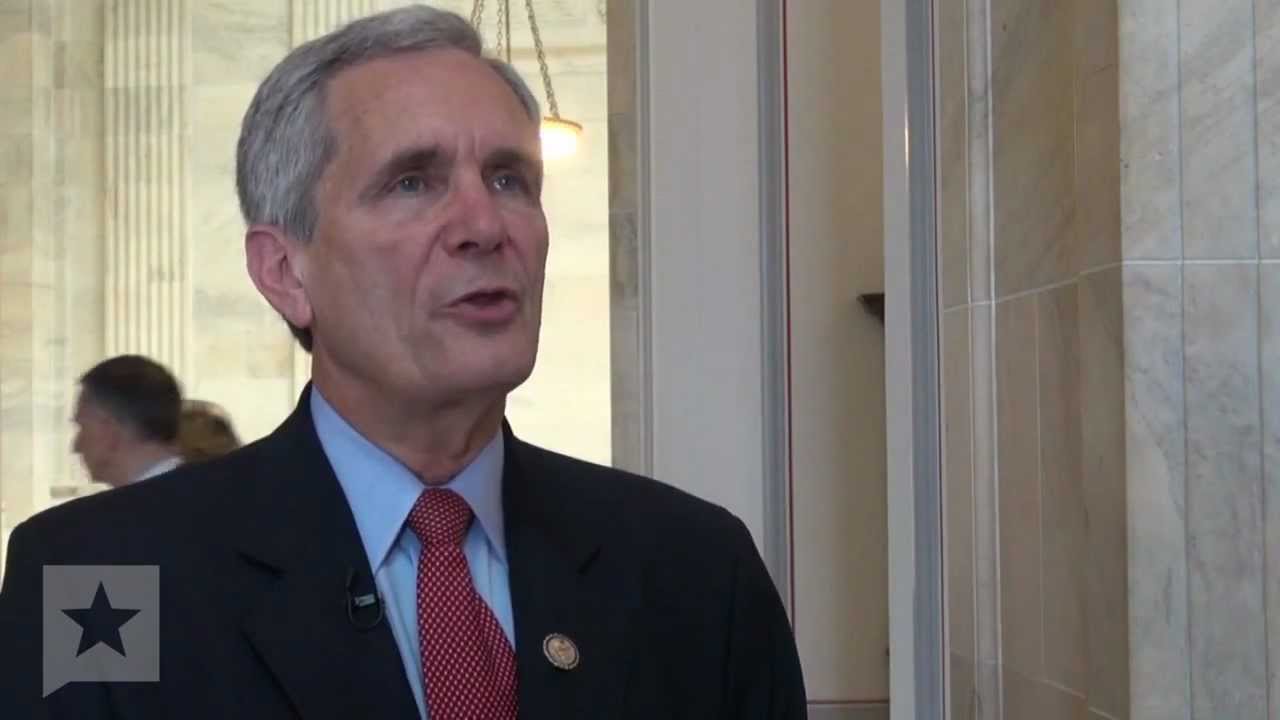
U.S. Rep. Lloyd Doggett
Of course, here in Texas, there is little we can do to stop the flow of red. A Democrat hasn’t won a statewide race in Texas in 20 years and that certainly won’t change tomorrow. I recently relocated from Dallas to Central Texas where my U.S. Representative, at least, is a progressive thinker and also a former associate from my days at the University of Texas, Lloyd Doggett. (Doggett was president of the UT student body which also made him head of student publications when I was the assistant managing editor of the university’s daily newspaper. We had numerous encounters in those roles.)

Wendy Davis
In Texas, the magic number progressives will be looking at is 42.3. That’s the percentage of the total votes won by Democratic gubernatorial candidate Bill White in 2010. This year the Democratic standard bearer is, of course, Wendy Davis, who is seen, by some (I am not among those) as the straw horse for an eventual Democratic takeover of the state. If this is true, she must win more than 42.3 percent of the vote. I would say, in order for her campaign to be called "successful," she needs to win at least 45 percent. If she wins less than 42.3 percent, her campaign will go down as an unmitigated disaster and a huge setback for Democrats’ hopes here in Texas, especially when you consider all the attention — even outside of Texas — Davis’s campaign has received. She is considered more than just a candidate by many; she has been elevated to "folk hero" status. It will also be interesting to see if she can collect significantly more than the 2.1 million votes White received four years ago. I sincerely hope she does, but I’m certainly not willing to wager anything of value on the possibility.
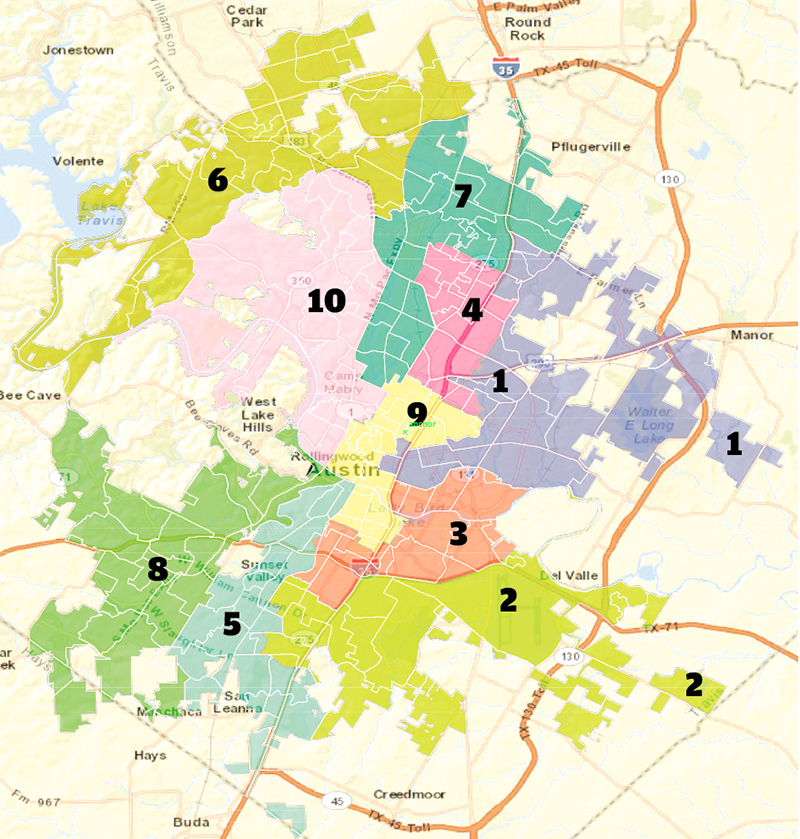
Austin's new 10 member city council districts
As a Dallas transplant as well as a significant player in the city’s transition from an at-large city council election system to a single-member district system, it’s fascinating to watch as Austin holds its first city election in which all 10 city council members will be elected from individual districts, with a mayor, of course, being the one at-large candidate. It’s interesting because in Dallas, where African Americans city council representatives fight tooth-and-nail to preserve four black city council districts, even though it could be argued the numbers no longer support that, in Austin only one district is considered winnable by an African American candidate and even in that district African Americans comprise only 35 percent of the voting age population. It would be enough to drive Dallas City Council members Dwaine Caraway, Carolyn Davis, Tennell Atkins and probably even Vonciel Hill over the edge. The black population here is quite evenly dispersed throughout all sections of the city because Austin leaders did not practice the systems of overt racism that resulted in the racially split North-South Dallas.

I will also give Austin credit for holding its municipal elections in November, which, of course, will mean more voter interest and a higher voter turnout than municipal elections in Dallas, which are held in May, when no other elections that might generate increased voter participation are on the ballot. On the other hand, I will give Dallas credit for doing rail right.

Austin voters will decide tomorrow if they want a light rail system in the city. I am a major proponent of mass transportation, especially in urban areas, but I have yet to make up my mind on Austin’s proposal. Dallas transportation visionaries (hopefully that’s not an oxymoron) wisely saw mass transportation as a regional issue and created, though a public referendum, a regional transportation authority that included 13 other municipalities in addition to Dallas. Plus, it isn’t just a light rail service: it operates buses, commuter rail and HOV lanes. DART is its own regulatory body. It is financed through sales taxes administered by all member cities.
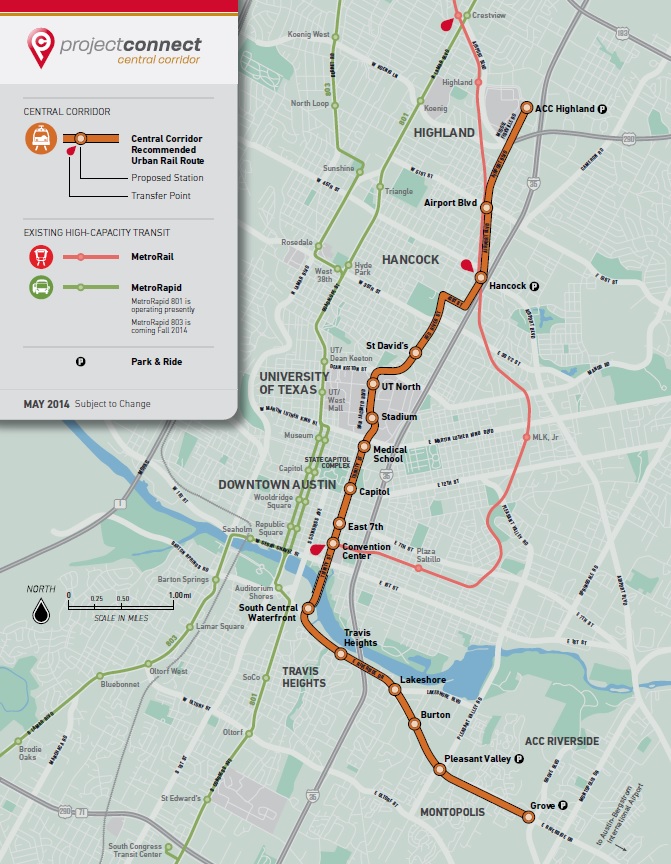
Austin's proposed rail line
Austin is going the light rail route on its own, with a proposal for only one line entirely within the city limits of Austin. It would be located along a north-south line just west of Interstate 35 until it crosses the Colorado river south of downtown where it would veer off to the southeast. One of the arguments against the rail proposal is that there is not that much rider ship along that corridor, that it should be located more to the west where more commercial areas are located. The problem is advocates agree with that assessment, but counter with the argument that "someday there will be more rider ship along the proposed route." I am not convinced that’s a compelling argument, but more than anything else I am chagrined that the rail proponents are thinking only locally and not regionally, especially when such neighborhood cities as Round Rock, Cedar Park, Kyle (my new home) and San Marcos (the fastest growing city in the United States the last two years) are growing as fast as they are. They need to be included in any transportation plan and Austin is shutting them out. In addition, the transportation system will be completely controlled by city government and will be funded by increased property taxes and a hoped-for windfall from the federal government (which probably won’t come if Republicans gain control of the Senate tomorrow).

I moved down here less than a month ago to retire close to the home of my son and granddaughter and I’m not going to live long enough the effects of mass transportation plans in Austin, let alone global climate change. (Neither are the heads of the oil and gas industries which is why they don’t give a damn if they destroy the planet – just as long as they continue to make their obscene profits). So I guess I shouldn’t be concerned about these things, but as the scorpion said to the frog, "It’s my nature." And if you don’t know what I mean by that last statement, rent and see the marvelous film The Crying Game, which, incidentally, a lot of us may be playing (the game, not the movie) this time tomorrow.

Wednesday, December 8, 2010

This is good for a couple of chuckles


This video purports to show us what driving east along LBJ will be like sometime around 2016. I don't care how many "managed lanes" (and I failed to see any "managing" in the video) are built under the main thoroughfare, can anyone in their right minds ever imagine so few vehicles on LBJ at any time during daylight hours? OK, maybe around 8 a.m. on a Sunday, but that's about it. I will give these mad men credit for one thing, however. It seems they found the solution to drivers darting in and out of the HOV lanes at will. However, if you decide go get into the "Managed" lane at I-35E, it doesn't look like you have a chance of escaping it until somewhere around North Central.

And I can visualize the internal debate in the typical driver's mind as he approaches LBJ. "Let's see, I can either pay to drive on this road or drive on it for free. Which shall it be? Pay or free? Hmmmm."

Sure. Fine. Whatever.

Tuesday, July 27, 2010

Oh, great! Transportation Department depending on junk mail to make intersection work

We can all sleep a little easier tonight, except for those thousands of you that flow through the intersection of Preston Road and Legacy Drive. And, according to this story, that's about 80,000 vehicles a day.

The Transportation Department has spent some $2.5 million of your tax money to reconfigure that intersection so that drivers cannot make a left turn. So, if you're driving west on Legacy and want to go south on Preston, you're going to have to go north on Preston instead. But only for a little while. Then you get to make a 180 to start traveling in your intended direction. It's called a Michigan left turn and I'm told it works magnificently up there where they have to make these U-turns in snow and ice a lot more often that you will. (I say "you," because I see absolutely no reason for me ever to be at that intersection.)

There are going to be signs up there telling people what to do, which will be absolutely worthless -- Texas drivers don't read road signs (i.e., "keep right except to pass," "do not cross double white line," any speed limit sign), or, if they do, they simply ignore them. But the Transportation folks had a backup notification plan: they notified drivers through the mail (how they identified the proper addresses is beyond me). So here, according to Mark Pettit, a Texas Department of Transportation spokesman, is the determining factor on how successful this Michigan left turn gambit will be:

"It really boils down to whether people threw away their junk mail," he said. "I hope they read it."

Yessiree, we can all sleep a lot easier tonight.

Monday, July 12, 2010

S.M. Wright arguments sound familiar

Jeffrey Muhammad, a member of a steering committee that's fighting TxDot plans to convert S.M. Wright Freeway in South Dallas into a six-lane roadway, thinks a better idea would be to re-design the freeway as a four-lane boulevard with commercial and residential development on each side. In others words, he doesn't want a highway going through this area, he wants a neighborhood-friendly street.

Muhammad makes sense to me and his arguments remind me of some of the reasons I was against the construction of a high-speed tollway as part of the Trinity River Corridor Project. Both the tollway and TxDot's plans for S.M. Wright are not designed for the folks who live here, but for those who drive through here.

TxDot claims a six-lane roaded is needed to accommodate all the traffic that will use the road. Muhammad correctly counters with the fact that a six-lane road will only increase traffic that would find alternative routes if the four-lane neighborhood boulevard is constructed.

Muhammad nailed it perfectly when he told the Dallas Morning News: "Why should people who pass through get more consideration than people who live here?"

I have been asking that same question for years.

Wednesday, April 28, 2010

DART's money woes

I'm not shedding any tears over the news that less-than-anticipated sales tax revenues likely will force DART to scrap plans for a second downtown rail line. It was a waste of money to begin with, a possible convenience but not a necessity. I never thought it would increase rail traffic enough to justify its construction. I worked at City Hall, where today city leaders have been lobbying for a rail station to be located on this second downtown line, and took DART rail to work almost daily. I never found it inconvenient to walk to the nearest station and, in fact, found a way to get from City Hall to the Convention Center station without ever leaving the shelter of a building. That came in handy during inclement weather.

DART sacrificed its opportunity to be a realistic viable transportation alternative when it opted more than a quarter of a century ago for light instead of heavy rail. For that reason DART will never have the appeal of the New York subway system, the Paris Metro or the London Underground, to name just three municipal rail services I have used frequently. Besides, Dallas is not really a city in the way New York, London, Paris, Boston, San Francisco, Moscoe etc are. Dallas is a comparatively small downtown business center surrounded by predominatly individualistic residential neighborhoods. Rail really doesn't work that well in a Dallas-type environment.

About the only troubling news in DART's financial revelations is the scrapping of the Blue Line extension that would have taken it to the Dallas campus of the University of North Texas. That line, to me, should have the highest priority of all the ones except the Orange line to DFW airport. I also find concern in that plans for additional HOV lanes will be scaled back almost 80 percent, even though most people in Dallas think HOV lanes are more of a transportation issue than an environmental one.

Monday, March 8, 2010

Adios, toll road

Right after voters approved the Trinity River Tollroad, I predicted I would not live long enough to drive the blasted thing. Now it's looking like I will not even live to see construction started on this ill-conceived project. The story starts out by saying it's all about the levees, but midway through readers will discover the real problem: It's all about the money, or rather the lack of it.

Sunday, February 7, 2010

Temporary rail line to Arlington to be installed for Super Bowl

According to Jeff Mosier of the Dallas Morning News, commuter rail service will be installed temporarily along an existing Union Pacific line to connect Jonestown with the rest of the world in time for next year's Super Bowl in Arlington. A temporary Super Bowl station will be located just north of the Arlington City Hall near Center Street, about a mile from the stadium. I am assuming shuttle bus service will connect the station and the stadium. The rail line will bring passengers from both Dallas and Fort Worth.

I'm betting very few will use it, simply because it is "temporary." Michael Morris, a host committee member and transportation director for the North Central Texas Council of Governments, told Mosier that Miami officials hoped some 3,000 riders would use its already existing rail service to attend last weekend's Pro Bowl. The actual number was closer to 300. And, as Bill Lively, president and CEO of the North Texas Super Bowl Host Committee, told Mosier of the Arlington line: "It won't be live the day before or the day after. No one here is going to be familiar with it. No one from out of town is going to be familiar with it."

So it seems like a lot of trouble to go to for the amount of use I'm betting it will get. And, why in heavens name, is the area trying to provide rail service to Arlington whose voters have repeatedly rejected mass transportation plans. They wanted gaudy sports stadiums instead. Let them deal with the transportation issues on their own. It's a simple case of "Be careful what you wish for." Besides, as Mosier points out in his story "Rail stops already exist near major Super Bowl venues, including the NFL Experience at the Dallas Convention Center and Taste of the NFL at the Fort Worth Convention Center."

Friday, January 8, 2010

If no one else will connect the dots ...


I find it startling that no one seems to have connected this story about how the state desperately needs more transportation money with this one, talking about he EPA's stricter smog controls. If Gov. Hair keeps refusing to enact measures to reduce smog in the state, we stand to lose federal transportation dollars.

And it continues to baffle me why state lawmakers continue to ignore the obvious solution to both problems -- a more widespread rail network. Here's what Vice President Joe Biden said on the subject just two days ago:

“With delays at our airports and congestion on our roads becoming increasingly ubiquitous, volatile fuel prices, increased environmental awareness, and a need for transportation links between growing communities, rail travel is more important to America than ever before."

There is one non-profit group, The Texas High Speed Rail and Transportation Corporation, that is trying to promote a system connecting cities in Arkansas, Oklahoma, Louisiana and Texas. That's all well and good, but bullet trains, while necessary, are only part of the solution. The state should be examining heavy rail as an alternative to all highway construction. I was dismayed that Dallas leaders were so short sighted that they never considered rail as an option to the Trinity River tollroad.

This is not, as the Morning News stories cited above might suggest, a city-by-city, region-by-region issue. Systematic change in the way this problem is addressed must come from the top levels of state government. If I were running things, one of the first steps I would take would be to name someone head of the Texas Department of Transportation who realizes (1) the state's environmental and transportation issues are irretrievably linked and (2) more highways are the least feasible solution to the state's transportation and environmental problems.

Another shift that needs to be made is changing the priority from how to get more transportation money to what this money should be spent on. A Texas Transportation Forum concludes today in Austin and from what I've read and heard, not one forward-thinking idea of any sense has come out of it. One idea that doesn't is a plan to tax drivers on the amount of miles they drive. That's an absolutely ridiculous idea. Why? First of all, drivers are already taxed that way -- the more miles you drive, the more gasoline you have to buy and the more gasoline you buy, the more transportation tax you pay along with that gasoline. But even more important it unfairly penalizes those who have tried to help the environment by purchasing fuel efficient or alternative fuel-vehicles. We should be providing more incentives to purchase these vehicles, not strip them away.

Wake up, Texas! Start thinking smart. It's later than you think.

Tuesday, September 15, 2009

TxDot's ulterior motive

I'm beginning to think the Texas Department of Transportation is taking all this secessionist talk by Gov. Hair and other Tea Party right-win nuts seriously. I mean, if Texas does secede, then there's no more federal highway funds--Austin becomes the federal government (which really is frightening when you think about it. Can anyone name another country of comparable size whose legislative body meets only 180 days every two years and still can't get anything done?)

But I digress. TxDot must be worried about a possible scarcity of funds should it secede (even though the state would probably get to keep a higher percentage of gasoline taxes, but what good is that with all these damn hybrids and alternative fuel cars on the road today?)

But I digress yet again. Somewhere in the bowels of TxDot's bureaucracy there's a brilliant mind who came up with a novel idea for getting the agency additional funds: "Let's design a license plate so hideous that drivers will pay extra to keep from having to put it on their cars."

I remember when the license plate was first proposed and, at the time, I thought it looked a tad garish. I can't remember all the details, but it was something like this: The state held a contest for 5th grade art students at an Austin elementary school and selected four-to-six finalists for the new plates. A graphic designer wasn't selected to do the plates because, remember, this is supposed to be a money-making, not a money-wasting proposition. The four-to-six finalists were then posted on the Internet and people went on-line to vote, exactly the same method used when the people of Dallas voted overwhelmingly to change the name of Industrial Boulevard to Cesar Chavez Boulevard. TxDot, unlike Dallas, didn't ignore the Internet vote even though it had more reason to ignore it than the city of Dallas did.

Like I said, I thought it was garish when I first saw it. And just sitting here on this page, it looks fairly benign. But lately I have seen it on cars and it looks downright hideous. I mean, it might be OK if you never plan to drive a vehicle with the new plates outside the state of Texas. If you do go beyond the state's borders with this plate, however, be sure to roll the windows up tight and have the stereo at full volume to drown out the laughter and the cat-calls.

However, there is an alternative. For an extra $30, you can order yourself a specialty license plate. I'm not talking about those vanity plates where you try to conceal something clever in as few letters as possible and no one but you can figure out what they mean. These are plates you can order and a small percentage of the proceeds from their sale can benefit the organization you choose to display on your plates. Texas has a whopping 188 choices of speciality plates available even as we speak and more are probably on the way. You can even order Dallas Cowboys specialty plates as though Jerry Jones needs more of your money than you have already given him. You can get a plate for just about any university in the state and a couple (LSU and Florida) that we wouldn't want here. You can get plates celebrating Big Bend National Park or Texas Music (but not Texas film), the Special Olympics, Boys and Girls Scouts, even Red Grapefruit.

I'm thinking TxDot fostered this new license plate on us to further the sales of these specialty plates. I know $30 may not sound like much, but you multiply that by the millions of Texas' registered vehicles and you're beginning to talk real money here. I know I will be ordering one so as not to have to dangle the new state plate from my car.

And I know which specialty plate Gov. Hair will be ordering. There's one that reads: "Texas -- It's Like a Whole Other Country."

Tuesday, August 25, 2009

NCTCOG sticks its toe in the water when it should dive in the pool


The Transportation Department of the North Central Texas Council of Governments will present a briefing today to the Dallas City Council's Transportation and Environment Committee on the notion of keeping 18-wheelers out of the left-hand lanes of freeways with three or more lanes. The briefing will say, according to COG's pilot study, this is a great idea for safety, air quality and mobility; that it is embraced by the public; and that an overwhelming number of truck drivers obey these rules without being forced to by the gendarmes.

So far, so good. But then slide 11 says don't implement these restrictions on freeways where it's really needed. The way I read this slide, titled "Corridors Proposed for Near Term Truck Lane Restriction Implementation," COG is only recommending these restrictions on I-45 from the southern Ellis County line to the road's terminus in downtown Dallas; I-20 from Spur 408 in extreme Southwest Dallas to where it joins I-30 west of Fort Worth; and I-20 from I-45 to around the Dallas-Kaufman County border.

Hey, what about I-35E where the majority of trucks travel? How about North Central Expressway? How about I-30, especially heading east?

If you're going to do this -- and you should -- do it right and where it will do the most good. If this half-hearted attempt is all COG proposes, it will give Gov. Hair another reason to try to revive his Trans-Texas Corridor boondoggle.

Thursday, July 16, 2009

An $80 million cosmetic surgery Dallas doesn't need

Dallas is seeking $80 million in federal transportation funds for the first phase of a streetcar system. Why? I dunno. The only reason I can think of is that City Council member Angela Hunt, a chief advocate of this ridiculous idea, went to Portland, Ore., saw the streetcars there and thought "Oh, that's so cool and so environmental -- we need to do that in Dallas."

Sure. Fine. Whatever.

Someone, anyone, please tell me what streetcars can do that the current and planned DART rail lines and bus service can't. Jarrett Walker, a public transit consultant from the aforementioned Portland, says essentially the same thing and he admits "I love riding streetcars." But he also states quite succinctly: "Streetcars that replace bus lines are not a mobility improvement. If you replace a bus with a streetcar on the same route, nobody will be able to get anywhere any faster than they could before."

So why spend $80 million on this boondoggle? I'm thinking it's nothing more than an image thing, window dressing, something to make Dallas appear more urbane, more sophisticated. Hey, I have an idea. Why not seek $80 million to find ways to create more foot traffic around the CBD -- plazas, fountains, esplanades, sidewalk cafes? That will accomplish the same thing and not waste money duplicating what we already have.

Wednesday, July 8, 2009

What to do about those dang HOV lanes

Apparently the members of the DART board aren't too happy with the HOV lanes along LBJ and north on 75 any more than the rest of us. They just don't know what to do about them. As usual, I have a solution.

Convert them from HOV Lanes to Express Lanes. Then the requirement for using them is not how many people you have in your vehicle but how far you need to travel.


It's interesting that we never hear or read about complaints involving the original HOV lanes that were created along I-30 east of downtown or the ones along I-35 south. It's also interesting that those lanes have concrete barriers that separate them from the rest of the highway.


So here's what you do. You build similar barriers for all the current HOV-Lanes-that-will-become-Express-Lanes. You have a minimum of entrance and exit points. (That's the problem with Texas freeways -- they were poorly designed. Freeways are supposed to be transit ways designed to carry vehicles over long distances in a short time. But the local engineers made sure that would never happen by creating freeways with entrances and exits less than a mile apart and stupid service roads that run alongside them, guaranteeing that most of the time the freeways would have all the mobility of a parking lot.) DART should extend the North Central Lane all the way to the Dallas CBD with entrances and exits only at its northern most point in Allen and flyover exits and entrances that connect to the George Bush Turnpike and LBJ Freeway. That way you are providing express service for those major traffic arteries and from the outer burbs to downtown Dallas.


The North Rim LBJ Express Lanes should have similar entrances and exits at 175/I20, I-30, North Central Expressway, I-35 and DFW.


Freeways are not supposed to be for those who just want to drive on them for 1-5 miles, but that's what they are in Texas and that's why they are so congested. I had the pleasure a couple of years ago of driving on England's Motorways one of which is pictured above), which are designed to get people over long distances in the shortest amount of time. In the metropolitan areas, there is never an entrance or exit closer to two miles of another one and in the rural areas, the standard is 25 miles between entrances and exits. I never once encountered a traffic jam on an English M-highway. It also helped that English drivers are far superior to Texas motorists, but then kamikaze pilots are safer than the majority of Texans on a highway.

Friday, June 26, 2009

You take the high road and I'll take the low road, but ain't no one taking a new road


According to Sam Merten at the Dallas Observer, there was a lot of opposition to all things concerning the Trinity River Corridor Project at last night's fourth and final City of Dallas Budget Frustration Exercise. Which again proves how little the local citizenry knows about how their local government works. For one thing, the overwhelming majority of TRCP funds come from bond monies already approved and it would be illegal to divert those funds anywhere else. OK, so maybe you can cut some staff from the office, but I guarantee you those staff members would wind up working someplace else at City Hall, so there's no savings there. And if you're talking about the infamous Toll Road that's designed to permanently scar the park? Well, if I read this correctly, there's mounting evidence that the dang thing is never going to be built anyway. The NTTA simply doesn't have deep enough pockets.

Wednesday, May 27, 2009

Once again Texas lawmakers prove they don't have a clue


I used to have this annual ritual that began every September. Each day for two months I would check the British Airways Web site to see what specials they were having. I remember one year, I found a three-day sale in which roundtrip tickets from DFW to London were $99 each. That was cheaper than flying from here to Austin. Of course, you had to travel between Nov. 1 and March 31, not the height of the tourist season in Great Britain, but for $99 who cares.

Another time I found a package deal on the BA Web site -- one week in London and one week in Paris for $600 a person. That price included all air fares and hotel costs. My son and I spent our first week in London and just as we were ready to check out of the hotel and take the train out to Heathrow, British Airways called to inform us that firemen were on strike in Paris (some outfit is always on strike in France.) Since firemen had to be on duty at the airport, that presented a problem. The airline said there were a number of possibilities -- our flight could takeoff and land as scheduled, it could be delayed or it could be cancelled. The caller gave us two options: (1) We could head to Heathrow and take our chances or (2) our tickets would be honored on Eurostar, the high-speed rail from London to Paris. I immediately chose option No. 2.

A couple of years earlier I had taken that same rail the other way, from Paris to London and I knew the benefits. The actual trip -- from hotel to hotel -- took much less time by rail than it did by air, mainly because of the time saved traveling from downtown to the far-flung airports in both cities. Plus, on the train, it was much easier to get out of your seat and walk around and, of course, the scenes out the window were far superior.

On the French side of the channel, the train reached speeds of almost 200 miles an hour. A couple of days after arriving in Paris, my son and I were standing on line waiting to get into the Louvre and we struck up a conversation with a French couple from Calais. They had driven to Paris and told us that they were driving close to 100 miles an hour on the main motorway when the Eurostar sped past them "as though we were standing still." (The picture above left shows the Eurostar arriving in the London station.)

I mention all this because, unless you have spent time enjoying rail travel, perhaps it's difficult to realize all the benefits it can bring. And perhaps it's because the dunces in the Texas Legislature have never enjoyed riding in anything but a Ford pickup, they are acting like idiots while discussing transportation options for the state, options they are making sure don't include rail.

While a group of farsighted North Central Texans (a phrase I once considered an oxymoron), tried to fashion legislation (albeit terribly misguided legislation) that would have funded about 200 miles of additional rail lines in the area, the Texas Legislature has decided that 25 percent of the money raised by this plan must go to schools and the other 75 percent can only be spent on highways and bridges.

This entire mess reminds me of the campaign used to convince Dallas-area voters to approve a .5 cent sales tax hike to fund the construction of rail in Dallas, what we now know as DART. The campaign was based on the notion that approval of this sales tax would decrease highway congestion in the area. Even then I thought that was the wrong argument and today we see traffic problems are worse than they were when this sales tax proposal was suggested.

But the real reason I thought that was a stupid argument was because of the "why." Why would someone be so interested in reducing traffic congestion. The only answer possible was so it would make it easier for that person to drive around town. In other words, they weren't going to be pried from their pickup truck. It's that same 200-years-behind-the-times attitude that still exists in this state.

It will still take elections to pass what the Legislature is considering -- a 10-cents-a-gallon gasoline tax increase to fund all this highway construction. I will do whatever I can (which is probably not all that much) to defeat such a proposal since I have gone on record many times as opposing any transportation option that does not include a rail component.

I must also add that I am crushed by the white-flag waving comments made by people like Rowlett Mayor John Harper who was quoted as saying "I suppose 'half a loaf' is better than none." (No, it isn't, John) and Michael Morris, transportation director for the North Central Texas Council of Governments, who said his staff would waste little time crying over the lost opportunity for rail -- they'd quickly follow with a list of road projects that counties could place before voters as soon as 2010.

That's the kind of cowardly leadership that will forever condemn Texas to remain 100 years behind the times.

Monday, May 4, 2009

Tomorrow's Trinity Toll Road hearing

I almost wish I could be at tomorrow evening's public hearing that will seek input into the location of the Trinity River toll road or whether the road should even be built in the first place.

I have been an opponent of this boondoggle from the very beginning for several reasons:

1. Just like you wouldn't build a high-speed thruway through New York's Central Park, San Francisco's Golden Gate Park, Los Angeles' Griffith Park, London's Hyde Park, you shouldn't build one through what should become Dallas' signature park. Can you imagine the uproar in East Dallas if someone proposed building high speed toll bridge over White Rock Lake? Can you picture the backlash in South Dallas if someone said we needed to construct a freeway through Kiest Park?

2. We should be concentrating on finding ways of getting people to Dallas, so they can spend their sales tax dollars here, not through Dallas, which this road does.

3. I am against any new transportation option that does not include a major rail component.

4. It will add more cars to our roadway infrastructure, more impurities to our air.

But this hearing is not going to be dealing with transportation ideology, I'm guessing, so none of the above would prove to be valid arguments there. However, I am hoping someone brings this to the attention of the feds.

Tuesday, April 28, 2009

Hutchison's gas tax plan wrong on several levels

Sen. Kay Bailey Hutchison, R-Texas, in a move designed more to boost her gubernatorial candidacy than anything else, plans to introduce legislation today that would allow Texas to keep all the money collected in taxes at the fuel pump. In other words, Texas would secede from the national highway program.

Her reasoning is that Texas is shortchanged because only 92 cents of every dollar we pay in federal fuel taxes ever finds its way back to Texas. Alaska, on the other hand, receives $4.21 for every dollar their citizens pay, so I'm doubting Hutchison's bill is going to get that much support from the big state up north.

Here are my problems with her idea. It's all highway driven and no transportation program or idea should be undertaken today without including some rail, especially high speed rail, components. And just when the federal government, thanks to the current administration, is beginning to address the nation's need for rail infrastructure, Hutchison's bill would exclude Texas from participation.

Second, according to the story about the bill in the Dallas Morning News, "Her Highway Fairness and Reform Act would let states keep all of the federal fuel taxes collected within their borders, on condition they use the funds to maintain interstate highways and for other road projects." Rail projects -- those that are needed the most here -- would be barred from receiving these much needed funds.

But, like I said, earlier, this legislation is not about solving Texas' transportation woes -- it's about positioning Sen. Hutchison against criticism from her probable GOP gubernatorial foe, Gov. Hair, who has accused the state's senior senator of not looking out for the best interests of Texas (as though Gov. Hair had looked out for the interests of anyone but the rich fringe right wing of the Republican Party).

If Hutchison was really interested in transportation in her home state she would demand an audit of the all the funds that Texas currently receives from both the federal and state gas taxes and then make sure more of those funds were dedicated to regional and statewide rail projects. We need to find ways to get polluting cars off the roads, not to build more roads to put more cars on.

Friday, April 17, 2009

High speed rail coming here?

President Obama outlined his plan yesterday on how to spend $8 billion in stimulus money for a much needed high-speed rail in this country. And the way I see it, we're in the picture although the plan, as it appears to be conceived right now, will not include high-speed rail from Dallas to Houston. There's a route that begins in Tulsa and goes to Oklahoma City, Dallas, Austin and ends in San Antonio. Then another that appears to begin in Dallas and goes to Little Rock with a stop in Texarkana. But, hey, at least it's a start.

Friday, April 10, 2009

Fees that could be used to fund Corona's transportation bill

A day or so ago, I editorialized about Sen John Corona's bill that would allow Dallas County Commissioners to impose taxes that would be used to fund transportation projects in the area. I said that the bill would allow the commissioners to raise the sales tax. That was incorrect. I have finally secured a copy of the proposal and it appears these are the fees the country can play with:
  • A tax on the sale of gasoline not to exceed 10 cents a gallon but which would be adjusted annually according to inflation.
  • A "mobility improvement fee, in an amount not to exceed $60" that would be "imposed on each person registering a motor vehicle in the county other than a person who initially registers a vehicle after acquiring the vehicle." (Huh?)
  • A $1-an-hour tax charged for using public parking places.
  • An annual motor emissions fee based upon the amount of pollutants your car ads to the Dallas air. The maximum tax here would be $15 a year. I'm guessing that would be added to the cost of your annual auto inspection.
  • Doubling the fee for renewing your driver's license with the added charge going into the transportation fund.
  • A maximum $250 "new resident roadway impact fee ... imposed on each person registering a motor vehicle previously registered in another state or country and collected at the time of registration."
Incidentally, the commissioners don't have to pick just one of the above options. They could impose as many of them as they think would be needed to get the job done each time they approved a new transportation project.

I still don't like this plan, even if sales taxes are not involved. My opposition, as stated earlier, is based upon my belief that:
  • Rail transportation, especially high speed rail transportation, which is desperately needed, is a regional, even a statewide issue, and shouldn't be approached on a county-by-county basis.
  • To impose these fees would require two votes: The first a statewide vote just to approve the concept and then local county-by-county votes every time the commissioners decided they wanted to fund another project. Frankly, in these economic times, I don't think highway loving Texans are going to vote to raise their own taxes for projects designed to pry them out of their pickups.
  • I still think someone should more carefully analyze where the money we currently pay in federal and state gasoline taxes is going and to report why those funds can't be used to fund these projects.

Wednesday, April 8, 2009

Carona's local option transportation bill does not seem like a good option


I learned from reading the Transportation blog written by Michael Lindenberger of the Dallas Morning News that the Texas Senate has passed Dallas Sen. John Carona's transportation bill, one that would allow counties to raise taxes and fees to fund transportation projects.

"But despite the win," Lindenberger writes, "prospects for the bill look cloudy."

Whew! For a minute there, I thought we were in trouble.

Look, I realize this city, this region ... hell, the entire state ... needs new transportation alternatives and by that I don't any more of Gov. Perry's toll roads that are designed only to line the pockets of his influential Spanish cohorts. In fact, we don't need more roads at all -- we should, in fact, be trying to find ways to force gas-guzzling, impediment-spewing vehicles off the roads that we do have.

Second, the last thing we need to do is to give our unaccountable county commissioners the power to raise our taxes because we all know how those tyrants will react -- "Let's add another half-percent to the sales tax." Let's just for a second put aside the fact that the sales tax is the most unfair tax ever levied on a public; instead look at the numbers. Sales tax revenue is plummeting. I've heard the City of Dallas' latest sales tax figures are even below its recently lowered expectations. So an increase in the regressive sales tax might fund a rail line from Highland Park to University Park, but that's about it.

I also don't think it's a good time to slap additional fees on auto registrations either, which is another likely avenue the commissioners might travel. I would take a look at an additional gasoline tax, but that brings me back to what really needs to happen.

We already pay a state and a federal tax on each gallon of gasoline we purchase at the pump. Does anyone really know where that money is going? Is the state tax going into a special transportation fund or just into the general tax pool? My fear is that the second option is the correct one. Wherever that money's going, it needs to be kept out of the hands of the Texas Department of Transportation because TxDOT is not a transportation agency, it is a highway department; it will only use the money to fund more road building and will use all of its considerable influence to make sure none of it is used for rail infrastructure.

Does anybody know (Eddie Bernice Johnson--Are you listening) what percentage of the federal gasoline taxes paid by Texans finds its way back to funding transportation needs in this state? How much of it comes back to Texas for any purpose? If it is less than 100 per cent, is anyone being held accountable for why?

I would like for Sen. Carona to investigate whether more careful management of the taxes we already pay might be a superior option to giving our county commissioners the power to raise additional taxes.

Not only that, transportation issues like the ones we're facing need to be addressed on a regional and even a statewide level, not a county one. What happens when Dallas County Commissioners vote to levy an additional tax for transportation needs and the commissioners of Collin and Tarrant counties reject the idea? This state desperately needs a high-speed triangular rail line linking Dallas/Fort Worth, Houston and San Antonio, but that's never going to happen if every county through which such a line would be built needed to go to constituents asking them to approve a tax increase.

I think I know Corona's motives behind this legislation and I agree with them: We in this area simply can't afford to wait for the rest of the state to get off its duff when it comes to funding rail construction. We need to find a way to jumpstart the process. He's right. But I don't think giving each county the option to raise taxes is the correct way to go about it. Not in these times, at least.

Sunday, April 5, 2009

I'm sorry, Mayor, but I just don't understand your reasoning here

On his Transportation Blog today, Michael Lindenberger of the Dallas Morning News had the following quote from Da Mayor concerning the levees and the proposed toll road in the Trinity River Corridor Project:

The genesis of this project was improving flood protection. So from the start, we fully expected that the components - including the Parkway - would be a part of that fix and must enhance the level of flood protection for Dallas. That planning must not stop because it only will delay the fixes longer. For instance, the Parkway component will enhance flood protection along its length with a wider and higher levee.

Someone needs to explain to me in language that I can understand (admittedly, that means simplistic) how the toll road will "enhance the level of flood protection for Dallas." At the same time, tell me why you need a toll road in order to have "a wider and higher levee."